
Best Mystery Anime Recommendations That Play Fair
Best mystery anime recommendations aren't just about shocking twists or last-minute killers appearing from nowhere. Any writer can hide information and pull a villain out of their hat in the final episode. Real mystery anime respect your intelligence enough to show you the pieces before they reveal the puzzle. They let you race against the detective, giving you every clue, every red herring, every subtle glance that matters. When the solution drops, you should feel stupid for not seeing it, not betrayed by lazy writing.
Most anime that call themselves mysteries are actually just thrillers with a big reveal at the end. There's a difference. A thriller keeps you guessing through confusion and misdirection. A mystery lets you solve it. The shows on this list understand that distinction. They range from grim psychological horror to cozy historical whodunits, but they all share one thing: they play fair with the rules of detection.
The Gold Standards That Never Cheat
Monster sits at the top of every list for a reason. Dr. Kenzou Tenma doesn't have magic powers or time travel. He's just a surgeon who made one ethical choice that spiraled into a nightmare. When he saves a young boy named Johan Liebert instead of the mayor, he doesn't know he's releasing a monster into the world. Nine years later, the bodies pile up, and Tenma has to hunt the man he saved.
What makes it brilliant isn't just the cat-and-mouse chase across Europe. It's how Naoki Urasawa plants every clue about Johan's past, his connections, his methods, right in front of you. The mystery isn't just "who is Johan" but "how do you stop a ghost who looks like a man." Every episode adds a piece to the conspiracy involving Cold War experiments, mysterious orphanages, and ruined villages. You can see the solution coming if you're paying attention, but you'll probably miss half the hints anyway. That's the mark of a solid mystery.
Pluto works the same way. Based on Urasawa's manga, this Netflix adaptation follows Gesicht, a robot detective investigating the murders of the world's most advanced robots and their human creators. In a future where robots have families and emotions, someone is killing them with a specific, brutal method. The mystery involves a missing robot boy named Atom and a force called Pluto that might be a weapon or a god.
The show gives you everything Gesicht sees. When he interviews witnesses, you hear what he hears. When he finds a clue, you see it on screen. The solution ties together themes of grief, war trauma, and what it means to be human, but it never cheats to get there. The killer's identity makes perfect sense in retrospect, and the clues were there from episode two if you knew where to look.
Supernatural Sleuths Who Follow Rules
Mononoke shouldn't work as a fair mystery. It's about a Medicine Seller wandering feudal Japan and killing spirits called mononoke. He uses a magic sword that only works if he knows the spirit's Form, Truth, and Reason. That sounds like made-up nonsense, right? Except the show treats these like actual detective work.
Each arc is a locked-room mystery with a supernatural twist. The Medicine Seller interrogates suspects, examines crime scenes, and pieces together the psychology of both the victims and the spirits haunting them. The Bakeneko arc, where a murdered bride haunts a train car, is a masterclass in showing you every witness testimony and letting you solve the injustice before the sword comes out. The art style is wild and colorful, but the logic is rock solid.
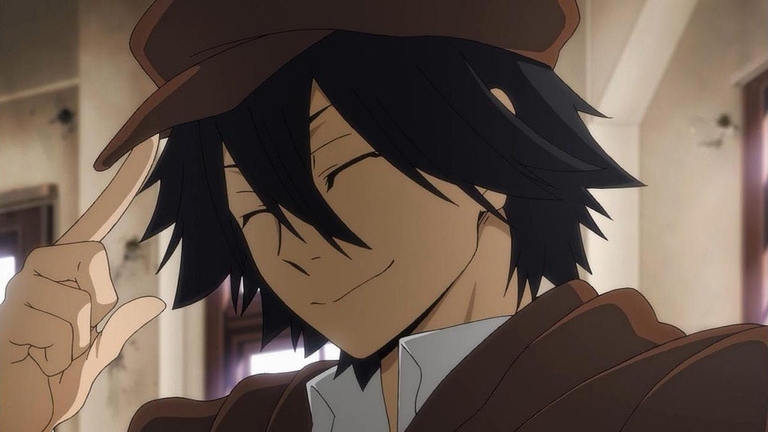
Bungo Stray Dogs starts rough. The first season focuses too much on comedy and random superpower fights. Stick with it. Once the show finds its footing around season two, it becomes one of the smartest supernatural mysteries out there. The Armed Detective Agency tackles cases that blend the occult with criminal psychology. When they face the Port Mafia or the Guild, the battles are won through information and deduction as much as through explosions.
The mystery of Atsushi Nakajima's bounty, the true nature of Dazai's past, and the identity of the decay angel all unravel through carefully placed clues across dozens of episodes. It's a long con that pays off because the writers planned it years in advance.
Time Loops Done Right
Time travel mysteries usually cheat. They change the rules mid-game or use paradoxes to handwave away logic. Erased almost cheats but pulls back at the last second. Satoru Fujinuma has a power called Revival that sends him back minutes before a tragedy to prevent it. When his mother is murdered and he's framed for it, he's sent back eighteen years to his childhood. He realizes the murder is connected to a string of child abductions that happened in his fifth-grade year.
The mystery of who killed his mother and the children isn't solved through time travel tricks. Satoru has to use his adult mind in a child's body to manipulate events and identify the killer from his limited pool of suspects. The show shows you every interaction, every suspicious glance, every bit of odd behavior from the townspeople. The killer's identity is devastating because you realize the clues were there in the first episode, but you dismissed them the same way a child would.
Summertime Render takes the time loop concept and weaponizes it. Shinpei Ajiro returns to his island home for his childhood friend's funeral. She drowned, but there are bruises on her neck. Then people start disappearing, and Shinpei realizes he's stuck in a three-day loop where shadowy doppelgangers are replacing the villagers. The mystery involves folk tales, time travel mechanics, and a conspiracy that spans generations.
What saves it from being a mess is how strictly it defines the rules of the shadows. They can only copy what they've seen. They have specific weaknesses. They operate on logic, not random horror movie villain behavior. Shinpei has to figure out who the original shadow is, how to stop the loop, and why his friend really died. Every loop gives him new information, and the show never contradicts its own rules to create fake tension.
Higurashi no Naku Koro ni is the ultimate example of fair play in a time loop structure. Keiichi Maebara moves to the village of Hinamizawa in 1983 and befriends a group of girls. Then people start dying around the Watanagashi Festival. The first season seems like a series of alternate realities where different characters snap and commit murders. The second season, Kai, reveals it's a single timeline stuck in a loop, and Rika Furude has been watching her friends die for a hundred years.
The mystery of who is behind the curse, why the village is trapped, and how to break the cycle is solvable from clues in the first season if you're paying psychotic attention to details like different character names in credits, slight changes in dialogue, and background newspaper articles. The solution involves government conspiracies, biological weapons, and a mastermind hiding in plain sight. When you rewatch it, you'll hate yourself for missing the obvious.
Classic Detection Without Superpowers
Gosick is a straight-up Gothic mystery that doesn't need magic. Kazuya Kujou is a Japanese exchange student in 1924 Europe who meets Victorique de Blois, a tiny genius who solves crimes from the library at the top of a tower. She has a photographic memory and deductive skills that put Sherlock Holmes to shame. Together they tackle cases involving ghost ships, alchemists, and royal conspiracies.
Victorique never guesses. She reconstructs the chaos of the world using fragments of information, and the show lets you play along. The mystery of her own origins, her mother's imprisonment, and the political machinations of the Saillune kingdom run through every episode, building to a conclusion that ties every loose thread together.
Detective Conan has been running for over a thousand episodes, and yeah, a lot of them are filler. But the Black Organization storyline, the mystery of why Shinichi Kudou was shrunk into a child's body, plays fair with its clues. The identity of the boss, the location of the organization's headquarters, and the roles of various undercover agents are all hinted at years in advance. When Rum was finally revealed, the clues had been sitting in episodes from the 1990s. That's commitment to the craft.
Modern Masterpieces You Might Have Missed
Odd Taxi came out of nowhere and blew everyone away. It looks like a cute animal cartoon. Hiroshi Odokawa is a walrus taxi driver who gets involved in a missing girl case that connects to the yakuza, corrupt cops, a struggling comedian, and a teenage girl running a pyramid scheme. The animation is simple, even cheap at times, but the writing is razor sharp.
Every passenger in Odokawa's taxi has a piece of the puzzle. The show drops hints about the true nature of the world and Odokawa's own perception of reality so subtly that you won't notice them until the final episode hits you like a truck. It respects the audience enough to trust that you'll remember a throwaway line from episode three that becomes the key to everything.
The Apothecary Diaries follows Maomao, a former pharmacist sold into service at the imperial palace. When the emperor's infants get sick, she solves the mystery using her knowledge of poisons and medicine. Unlike most mystery protagonists, she doesn't want credit. She wants to be left alone to read books and eat snacks. But her deductions are too good to ignore, and soon she's solving adultery scandals, poisonings, and political plots in the inner court.
The mysteries are grounded in historical pharmacology and court politics. Maomao figures out how a concubine was poisoned by knowing which flowers bloom in which seasons, or how a fire was started by understanding the properties of makeup powder. It's a cozy mystery with teeth, and every solution is earned through observation, not coincidence.
Sci-Fi That Questions Reality
Serial Experiments Lain is dense. It's about a girl named Lain who gets an email from a dead classmate and starts exploring The Wired, a virtual world that might be more real than physical reality. The mystery involves who Lain really is, what The Wired represents, and whether reality is just a consensus hallucination.
It doesn't explain itself with exposition dumps. You have to piece together the fragments of psychological horror, technological paranoia, and philosophical questions about identity. The clues are in the backgrounds, in the distorted voices, in the repetition of certain phrases. It's not for everyone, but if you want a mystery that respects your ability to interpret symbolism, this is it.
Psycho-Pass starts as a police procedural in a future where computers scan your brain to determine if you're a criminal. Inspector Akane Tsunemori joins the force believing in the system, but she starts noticing flaws. The mystery of who is manipulating the crime coefficients, who the true villains are, and what the Sibyl System actually is unfolds across the first season with brutal efficiency.
The villain, Shogo Makishima, isn't hiding in the shadows. He's in plain sight, and the show gives you every hint about his philosophy and his connections to the victims. The real mystery is how Akane will stop him within a system that protects him.
ID:Invaded is about a technology that lets detectives dive into the subconscious minds of killers to gather clues. The id wells are dreamlike landscapes built from the criminal's obsessions. The protagonist, Akihito Narihisago, is a former detective imprisoned for murdering his daughter's killer. He enters these minds to solve cases from inside a cell.
The rules of the id wells are strict. Only killers can enter. The wells reconstruct the crime scene based on the perpetrator's cognitive particles. The detective has to identify the victim, the method, and the motive from symbolic representations. It's a high-concept mystery that never breaks its own logic for a cool visual.
Why Fair Play Matters
When a mystery anime hides the killer until the last second with no clues, it's not a mystery. It's a magic trick where the magician never showed you the deck. The shows listed here understand that the audience isn't stupid. They want the satisfaction of being outsmarted fairly, not lied to.
Monster, Odd Taxi, The Apothecary Diaries, and Higurashi all operate on this principle. They give you the same information the detective has, and if you're sharp, you can beat them to the solution. That's the contract between mystery writer and reader, and these anime honor it.
Start with Erased if you want something short and punchy. Go with Monster if you want the full psychological experience. Try Gosick if you like historical settings. Just don't expect any of them to hold your hand or pull a rabbit out of a hat in the finale. The clues are there. You just have to pay attention.
Further Reading:
Frequently Asked Questions
What makes a mystery anime play fair versus cheating?
Fair play mystery anime give the audience every clue needed to solve the case alongside the detective. They don't hide information or introduce killers in the final episode without foreshadowing. Shows like Monster and Odd Taxi let you see the evidence as the characters see it, so the solution makes sense when it's revealed.
What is the best mystery anime for beginners?
Start with Erased if you want something short with a time travel twist, or The Apothecary Diaries if you prefer historical settings with cozy but clever mysteries. Monster is the best for a deep psychological thriller, though it's much longer at 74 episodes.
Do supernatural mystery anime count as fair play?
Some do, like Mononoke and Bungo Stray Dogs, but they establish strict rules for how the supernatural elements work. The mystery comes from figuring out the human or spirit motivations within those rules, not from random magic solving the plot.
Which mystery anime has the best plot twists?
Higurashi no Naku Koro ni is the best example. The first season seems like random horror, but the second season reveals a complex time loop mystery where every violent event is part of a solvable puzzle involving government conspiracies and biological weapons.
What is Odd Taxi about?
Odd Taxi looks like a simple cartoon about animals, but it's a tightly written noir mystery about a missing girl case that connects to the yakuza, corrupt police, and a struggling comedian. Every character who enters the taxi has a piece of the puzzle.