
Gabimaru's Fight Against the Immortal Tensen in Hell's Paradise
Hell's Paradise: Jigokuraku tensen lore and gabimaru's journey starts with a guy who can't die getting sentenced to death. Gabimaru the Hollow, real name Saku, is the 58th generation of elite Iwagakure assassins trained to feel nothing. He's survived burning, boiling, and blade executions because his body is basically a weaponized human tank, but he wants to die until he remembers his wife Yui. Then he wants to live. The Shogunate offers him a deal: go to this cursed island called Kotaku, find the Elixir of Life, and get a full pardon. Simple enough except the island is run by seven immortal beings called the Lord Tensen who use an energy called Tao to turn people into trees.
The place is called Shinsenkyō by some, but the natives call it Kotaku, and it's a biological nightmare where the trees have human faces and the butterflies carry parasites that turn you into wood. Gabimaru gets paired with Yamada Asaemon Sagiri, an executioner who can cut heads off with one swing but struggles with her own worth as a samurai woman. Together with other death row convicts and their executioner babysitters, they land on this rock only to find out the previous five expeditions didn't just die; they bloomed. The island is a giant laboratory created by Rien, a grieving widow who's been trying to resurrect her husband Jofuku for a thousand years using Chinese alchemy and botany. The Tensen are her synthetic children who can shift genders and transform into monsters, and they've been farming humans for centuries.
What the Tensen Actually Are
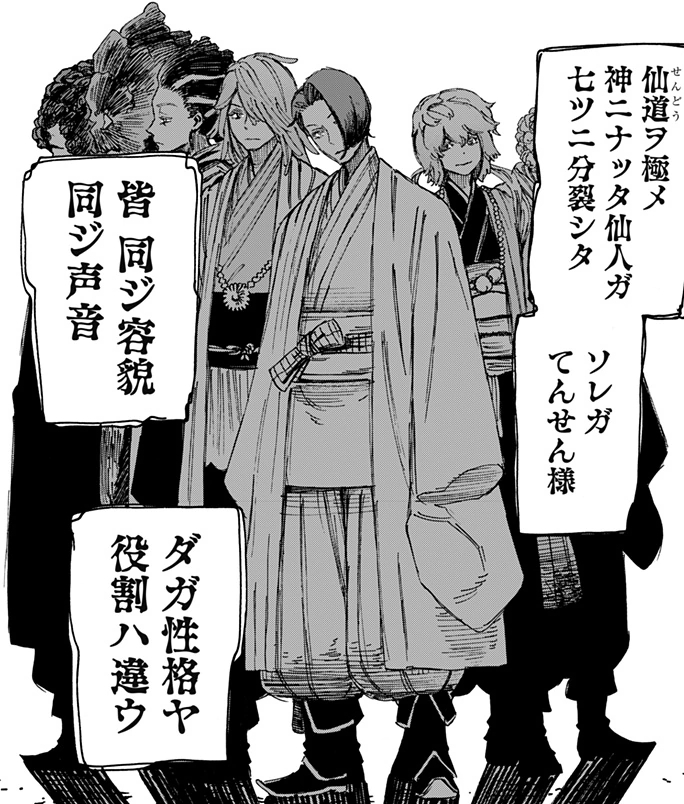
The Tensen aren't natural creatures. Rien created them from a single Tao puppet over a thousand years ago, modeling them after the Eight Immortals of Chinese mythology but twisting them into synthetic guardians for her island laboratory. You've got Zhu Jin, who looks androgynous and chill until they turn into a plant dragon. There's Mu Dan, who seems polite but transforms into a giant centipede-thing with a face that nightmares are made of. Tao Fa is the "friendly" one who wants to teach humans about Tao, but she'll still turn you into fertilizer if you mess with her garden. Ju Fa is obsessed with "intimate congress" and regeneration. Ran is the mathematician who calculates every move. Gui Fa is the observer who records everything. And Rien is the mother of them all, the true mastermind who used to be human but replaced her body with plant matter to survive long enough to revive her husband.
Each Tensen can shift between male and female forms at will, which isn't just a cool visual trick. It represents the Daoist concept of balance between yin and yang. They don't see gender the way humans do because they're literally plants that happen to look human. Their immortality comes from Flower Tao, which means if you cut off their head, vines grow out and reconnect it. If you burn them, they regenerate from ash. The only way to kill them is to disrupt their Tao flow with the opposing elemental attribute, which is why Gabimaru's Fire Tao is so important. When they get serious, they enter Kishikai, shedding their human forms entirely to become massive botanical horrors. Zhu Jin fuses with the Banko, a giant tree monster that basically becomes the final dungeon of the island. These aren't villains with tragic backstories revealed at the last minute; their tragedy is that they were created to love a mother who only sees them as tools to resurrect a dead man.
How Tao Works and Why It Changes Everything
Tao is the entire combat system of the second half of the series, and it's weirdly technical for a shonen battle system. Everyone has a Tao attribute based on their personality and nature. Gabimaru is Fire because he's passionate and destructive but also protective. Sagiri is Water because she's adaptive and flows around obstacles. Yuzuriha is Wood because she's flexible and growth-oriented. The system works on a destruction cycle: Fire melts Metal, Metal chops Wood, Wood absorbs Earth, Earth dams Water, Water extinguishes Fire. If you hit a Tensen with their weakness, you can bypass their regeneration.
But using Tao isn't about screaming louder or getting angrier. It's about achieving a state where your body and mind are perfectly synchronized. Gabimaru can't use Tao at first because Iwagakure trained him to suppress his emotions. He has to "feel" the Tao flow in his body, which means he has to stop being "the Hollow." Mei, the Tensen child who defects to the humans, teaches him that Tao is about sensing the life in everything. You can use it to read your opponent's intentions, find weak points in armor, or suppress your presence entirely. The convicts who figure this out, like Chobei and Gantetsusai, go from being strong humans to being able to trade blows with gods. Those who don't, like most of the first expedition, become trees.
The Dōshi, the island's priests who serve the Tensen, can use basic Tao techniques. They throw their weapons infused with Tao energy or create barriers. But the Tensen themselves manipulate Tao on a cellular level, which is why they can regenerate. When Gabimaru finally awakens his Fire Tao during a fight with two Dōshi, it's not a sudden power-up. It's the result of him accepting that he wants to live with Yui, that he has something to lose. The fight choreography changes after this point because now battles are about Tao prediction and elemental counters rather than just sword strikes. The mythology behind the series draws heavily from Chinese and Japanese folklore, which makes the power system feel grounded in something older than typical anime energy blasts.
Gabimaru's Memory Loss and Regression
There's a brutal arc where Gabimaru overuses Tao and gets amnesia. He forgets Yui, forgets Sagiri, forgets that he wants to be human. He reverts to Saku, the child who was raised in a pit and taught to kill his own parents' killers. This section is hard to read because he attacks his allies. He fights Chobei, the Bandit King, in a battle where neither can die; Chobei because he's adapted to Tao, Gabimaru because he's too stubborn to know when he's beaten.
The scary part is how efficient he is without emotions. He fights like a machine, calculating kills without hesitation. It proves that Iwagakure's training worked; they created the perfect weapon. But it's Sagiri who brings him back, not through a speech about friendship, but through Tao restoration. She literally reconnects his life energy flow, which requires physical contact and trust. This arc matters because it shows the alternative path Gabimaru could have taken. Without Yui, without Sagiri's intervention, he would have become exactly what the Tensen are: immortal, powerful, and completely alone. Details on Gabimaru's character arc show how this regression was planned from the start of his training.
The Island of Kotaku as a Biological Trap
Kotaku itself deserves discussion because it's not just a setting. It's a ship. A literal ship created by Xu Fu (Jofuku) and Rien using ancient Chinese alchemy and botany. The island moves, has defense systems like the Wadatsumi (eel-like monsters with human faces), and a filtration system that prevents anyone from leaving through the floodgates unless they have specific Tao signatures. The geography changes based on the Tensen's will. Hōrai Palace at the center is a fortress of biological horror where humans are processed into Tan.
The "arborification" process is the island's digestive system. When humans can't handle the Paradise Butterflies or the Tensen's attacks, they turn into trees. These trees then bloom and spread spores, continuing the cycle. The Sōshin, the mud-like soldiers that attack the convicts, are basically white blood cells. Everything on Kotaku is designed to harvest Tao from living things to create the Elixir. Even the pretty parts of the island, the fields of flowers and the misty mountains, are part of the trap. It's beautiful and deadly, which fits the series' aesthetic perfectly. The island arc breakdown covers how the survivors navigate these specific hazards.
The Supporting Cast and Their Survival Methods
Yuzuriha, the kunoichi who initially seems like she's going to be the "sexy traitor" archetype, ends up being one of the most solid characters. Her Tao is Wood-attribute, and she uses it to manipulate her body in gross but effective ways, like secreting mucus to slip out of holds or hardening her skin. She teams up with Gabimaru not because she likes him, but because survival requires it. Her dynamic with Senta, her executioner who dies protecting her, adds weight to the story.
Chobei Aza and his brother Toma represent another path to power. Chobei is a bandit king who fights like a berserker, but he's smart. When he gets "eaten" by a Tensen, he doesn't die; he absorbs their Tao from the inside and becomes a hybrid. His brother Toma infiltrated the Yamada clan to rescue him, showing that family bonds exist even among criminals. Gantetsusai Tamiya, the "Blade Dragon," is just a swordsman who loves fighting, but his straightforward approach contrasts with the complicated Tao system. He can't use Tao at first, but he learns to sense it through sheer combat instinct.
Shugen, the 2nd-rank Asaemon who leads the second expedition, is the worst. He's a fanatic who believes in "justice" so hard that he kills indiscriminately. He represents the danger of rigid thinking compared to Sagiri's flexible approach. When he arrives on the island, he doesn't try to understand the Tensen; he just tries to cut them, which doesn't work because he doesn't understand Tao. His presence raises the stakes because now Gabimaru has to fight the Tensen and other humans who want to kill him.
The Truth About Yui and Why It Matters
The series teases hard that Yui might not be real. Shija, the Iwagakure shinobi who's obsessed with Gabimaru, claims Yui is a genjutsu or a puppet created by the chief to control him. There are hints that the chief's daughter might be an illusion. This creates genuine tension because if Yui is fake, then Gabimaru's entire motivation is based on a lie.
But the story resolves this by saying it doesn't matter. Even if Yui was initially a tool of control, the love Gabimaru feels is real, and the person he became because of that love is real. When he finally reunites with her at the end, she's real, but the point stands: emotions create reality. The chief wanted to use Yui to make Gabimaru weak, but instead she made him strong enough to survive the island. The Reddit discussion about this turned up some interesting theories, but the manga confirms she's alive and waiting. The emotional core isn't about whether she exists; it's about Gabimaru's capacity to love saving him from becoming a monster.
Rien and the Final Battle Structure
The last third of the series reveals that the Elixir is complete, and Rien plans to take it to Japan to harvest the entire population's Tao to perfect the resurrection of Jofuku. This raises the stakes from "survive the island" to "save the world." Rien isn't a cackling villain; she's a grieving widow who spent a thousand years trying to bring back the one person who saw her as human. Her Kishikai form is a massive combination of plant and machinery, a grotesque wedding dress of vines and flowers.
The final battle involves both landing parties teaming up, which is messy because some of them hate each other. Gabimaru has to fight Rien while dealing with Shugen trying to kill him. He enters his own pseudo-Kishikai state by injecting himself with Flower Tao, gaining regeneration but risking full arborification. The fight ends not with a giant explosion but with Gabimaru refusing to destroy Jofuku's body because he understands Rien's love. He sees Yui in his mind and realizes that destroying someone's chance at love would make him no better than the Tensen. Sagiri delivers the final blow, not Gabimaru, which is important because it shows he's stopped being a solo killer and become part of a team.
Why the Tensen Lore Works
Hell's Paradise avoids the power creep trap by making the final victory about understanding and empathy rather than a bigger fireball. Gabimaru doesn't surpass the Tensen in raw Tao; he outsmarts them or appeals to their humanity. The lore about the Eight Immortals and Chinese alchemy adds depth that most battle manga skip. The body horror of arborification keeps the stakes real because you can see what happens to the losers.
The series also doesn't overstay its welcome. At 120 chapters, it tells a complete story with a beginning, middle, and end. Gabimaru starts as a hollow shell and ends as a smiling man who can sleep without nightmares. The Tensen start as invincible gods and end as tragic children who never asked to be born. The island goes from a mystery to a graveyard to a place that can finally rest.
Hell's Paradise: Jigokuraku tensen lore and gabimaru's journey works because it connects the supernatural mechanics to emotional truth. You can't master Tao without understanding yourself. You can't beat the Tensen without accepting vulnerability. The island is a metaphor for grief and obsession, and Gabimaru's survival depends on rejecting the toxic masculinity and emotional suppression that Iwagakure drilled into him. It's a solid series that doesn't waste your time with filler, and the Tensen remain some of the most unique antagonists in recent shonen because they're not just evil; they're broken people created by a broken system.
Frequently Asked Questions
What is Tao in Hell's Paradise?
Tao is the flow of life energy inside all living things in Hell's Paradise. It's categorized into five elements (Fire, Water, Wood, Metal, Earth) that counter each other in a destruction cycle. Unlike typical anime power systems, you can't use Tao by just training harder; you have to achieve emotional balance and synchronize your mind with your body.
Who are the Lord Tensen?
The Lord Tensen are seven synthetic humans created by Rien from a single Tao puppet over a thousand years ago. They're based on the Chinese Eight Immortals but twisted into immortal plant beings who can shift genders, regenerate instantly, and transform into monstrous Kishikai forms. They harvest human Tao to create the Elixir of Life.
Is Gabimaru's wife Yui real or an illusion?
Yes, Yui is real. While the series teases that she might be a genjutsu or illusion created by the Iwagakure chief to control Gabimaru, the ending confirms she actually exists and is waiting for him. Thematically, whether she was real or not doesn't matter because the love Gabimaru feels is real and transforms him from a hollow killer into a human being.
What is arborification in Hell's Paradise?
Arborification is the process where humans on Kotaku turn into trees. It happens when someone is exposed to Tan or Tao they can't process, causing flowers to bloom from their bodies until they become wooden statues. It's irreversible and the primary fate of those who fail to survive the island's trials.
What is the island of Kotaku?
Kotaku is actually a massive ship created by Rien and Jofuku using ancient Chinese alchemy. It's a mobile laboratory designed to harvest Tao from living beings to create the Elixir of Life. The entire ecosystem, including the monsters and the arborification process, is part of Rien's thousand-year experiment to resurrect her dead husband.