
Gakkou Gurashi Is a Mental Breakdown Disguised as a Cute Anime
You think you're watching another season of K-On! for the first twelve minutes of Gakkou Gurashi. That's the point. Gakkou Gurashi explained through its themes and twists isn't really about the undead at all. It's about what happens when a teenage brain encounters trauma so severe it rewires itself to keep functioning.
The show doesn't trick you for shock value. It tricks you because Yuki Takeya is tricking herself. When the camera pulls back at the end of episode one to reveal the ruined hallways and barricaded windows, you realize you've been seeing the world through a broken filter. The primary keyword here matters because explaining this show means explaining how denial works as a survival tool. Not as a weakness. As a necessity.
Gakkou Gurashi isn't really about zombies. The zombies are just set dressing. The show is about four girls keeping a fifth girl from falling apart, and in doing so, keeping themselves together. It's about how the brain protects its owner when reality gets too loud. The first episode is famous for the rug pull where you realize the school is destroyed and everyone is dead except these four girls and a dog. But that twist is just the setup. The real work the show does happens in the quiet moments where everyone's pretending everything is fine while standing in a room with boarded-up windows.
If you dropped the show after episode one because you thought it was just a gimmick anime relying on a single twist, you missed the point entirely. The gimmick is the delivery system for a story about psychological survival. The girls aren't fighting zombies half as much as they're fighting despair. That fight looks like cooking classes and morning exercises because that's what keeps them human. The alternative is sitting in the dark waiting to die.
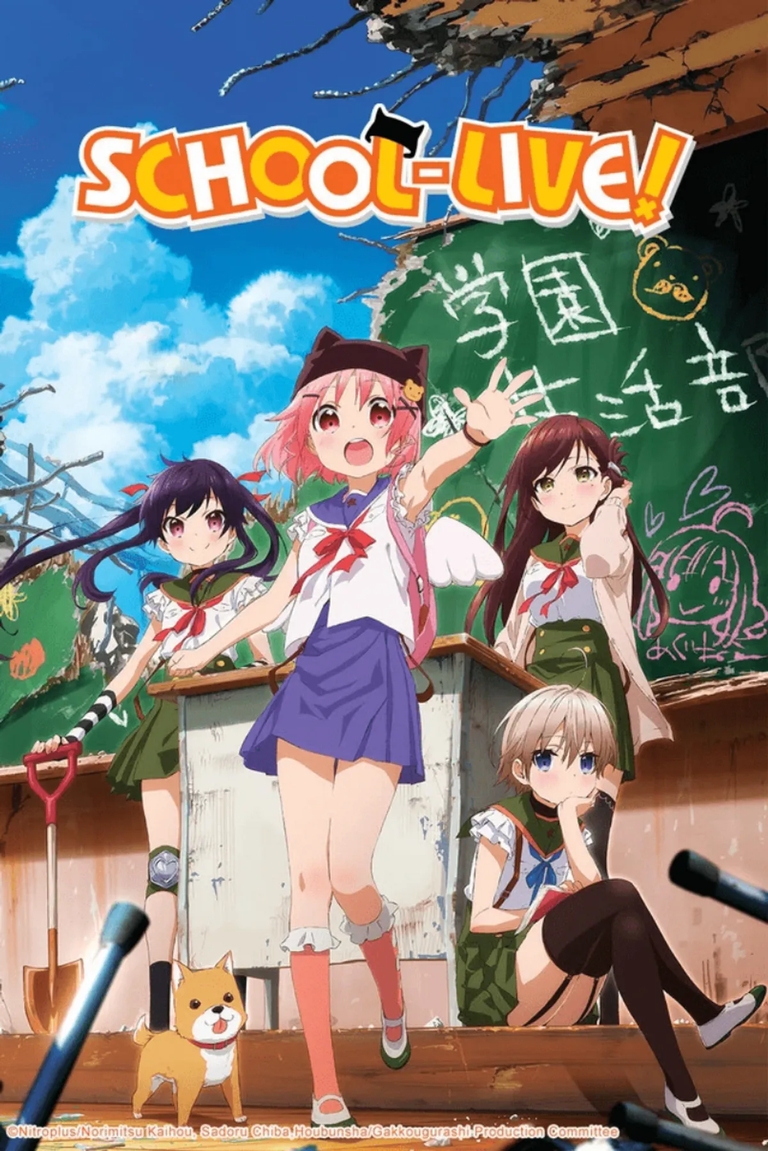
The Episode 1 Punch to the Gut
The first episode of Gakkou Gurashi is a masterclass in deception. You get the upbeat opening song with the girls running through clean hallways and waving flags. You get Yuki's internal monologue about how much she loves school. You get the generic slice-of-life comedy beats. Yuki talks to her teacher Megu-nee. She plays with the dog Taroumaru. She attends class with her friends Kurumi and Yuuri. Everything is pink and soft and full of light.
Then the camera pulls back. You see the bloodstains on the walls. You see the barricades made of desks and chairs. You see that the classroom Yuki is sitting in is actually a wrecked safe room on the second floor. You see that when Yuki waves to a student in the hallway, that student is a zombie with its intestines hanging out. The show doesn't use a sound cue or a musical sting. It just shows you. And it's terrifying because of how quiet it is.
This isn't just a twist for shock value. The show establishes immediately that your perspective is broken. You're seeing the world through Yuki's eyes, and her eyes are lying to her. The other girls play along because they need her to stay functional. Kurumi carries a shovel everywhere and smashes skulls with it when Yuki isn't looking. Yuuri cooks meals from expired canned goods but calls it a special recipe when she serves it. They're maintaining the fiction because the fiction is keeping them alive. If Yuki breaks, the group loses its center. If the group loses its center, they stop having reasons to get up in the morning.
The marketing for this show was perfect deception. The early key visuals showed the girls smiling with no hint of the apocalypse. The opening theme changes every single episode to include more broken glass and blood spatter as the season progresses. By episode twelve, the same cheerful song plays over images of the school in ruins. It's not just a cute trick. It's the show telling you that the facade is cracking week by week.
Yuki's Broken Brain Is the Real Story
Everyone talks about the zombie twist but nobody talks enough about Yuki's psychosis. She isn't just pretending things are normal. She has a full dissociative disorder. When she sees a zombie, her brain edits it into a friendly classmate waving hello. When she walks through a hallway full of debris, she sees clean floors and open windows. This isn't cowardice. It's her psyche doing exactly what it needs to do to keep her breathing.
The show treats this with surprising respect. It doesn't mock Yuki. It doesn't paint her as useless. It shows how her condition is both a burden and a gift. The other girls protect her delusion because her delusion gives them structure. If Yuki believes they have to go to class, they have a reason to get up in the morning. If she believes they need to have a sports festival, they have a reason to clear the courtyard of monsters. Her mental illness becomes the organizing principle for their survival. She gives them homework assignments. She insists on attendance. She creates a schedule. Without that schedule, they're just refugees waiting to die.
But brains can't filter reality forever. Episode 10 is where the dam breaks. The school gets breached. The zombies get inside the building. Kurumi gets bitten. Yuuri loses her grip. Yuki sees a zombie in the classroom and her brain can't rewrite it fast enough. She has to choose between the fantasy and saving Kurumi's life. She chooses reality. That moment isn't just plot progression. It's a psychological breakthrough that twelve episodes built toward.
The Megu-nee Twist and Why It Hurts
Midway through the season you find out that Megu-nee, the teacher who advises the School Living Club, is dead. Has been dead since before the show started. Yuki is hallucinating her. The other girls can't see her. When Yuki talks to Megu-nee in the hallways, she's talking to empty air. When Megu-nee appears in the classroom, she's occupying a chair that the other girls leave empty out of respect for Yuki's illness.
This reveal works because the show cheats fair. Megu-nee never touches anyone except Yuki. She never opens doors. She just appears in rooms already inside. She never eats. She never changes clothes. The show gives you all the clues but your brain ignores them because you're trained to accept anime logic. You assume she just walked in off-screen. But no. She's a ghost. Or rather, she's a guilt complex given form.
Megu-nee died saving the girls. She locked them in a safe room and got bitten doing it. Yuki's brain resurrected her as a way to process the trauma of that death. And here's the messed up part that makes Gakkou Gurashi darker than most horror anime. The show later reveals that Megu-nee's corpse is still wandering the school as a zombie. So Yuki's comforting hallucination and the actual monster are the same person. That's not just sad. It's psychologically brutal. It means Yuki can't kill the zombie Megu-nee without killing the hallucination Megu-nee. She has to lose her teacher twice.
Five Girls, Five Ways to Fall Apart
People have mapped the main characters to the five stages of grief and it tracks too well to be accidental. Yuki is Denial. She lives in a fantasy world where school never ended. Kurumi is Anger. She kills zombies with a shovel and has serious rage issues that she channels into violence. Miki is Bargaining. She spent time alone in a mall trying to trade her safety for her sanity before joining the group. Yuuri is Depression. She holds it together for the others but she's crumbling inside and carrying a stuffed animal that represents her dead sister. Megu-nee is Acceptance. She's dead and at peace.
Whether the writers did this on purpose or not doesn't matter. The mapping works. Each girl represents a different response to trauma. Yuki retreats inward to a safe place. Kurumi lashes outward with her weapon. Miki tries to negotiate with the new reality by finding logical solutions. Yuuri absorbs everyone's pain until she breaks down in episode 10. And Megu-nee represents the endpoint they're all heading toward unless they find a way to process their grief.
This is why the character work in Gakkou Gurashi hits harder than it should. You aren't just watching cute girls. You're watching coping mechanisms walk around in school uniforms. When Yuuri starts talking to her teddy bear like it's her little sister who died years ago, it's heartbreaking because you realize she's been carrying that death with her since before the zombies showed up. The apocalypse just gave her an excuse to finally crack.
The Mall Arc and Miki's Cynicism
Miki Naoki doesn't show up until later because she was trapped in a mall with her friend Kei when the outbreak happened. Kei was the optimistic one who believed help was coming. Miki was the realist who knew they were on their own. Kei got impatient and left the safe room. She died. Miki survived alone for weeks with only a book and a flashlight before the School Living Club found her.
When Miki joins the group, she represents the threat of reality. She doesn't play along with Yuki's delusions. She finds them annoying and dangerous. She wants to survive, not pretend. Her arc is about learning that pure pragmatism will kill you just as fast as pure fantasy. She learns to play along with Yuki's games not because she believes them, but because she understands that hope is a resource you have to manufacture sometimes.
The Opening Credits Are Lying to You
Watch the opening theme for episode one. Then watch it for episode twelve. They're completely different songs visually. Episode one has them running through clean hallways with bright colors. By episode twelve the same shots have blood on the walls and zombies in the background. The animation team updated the OP every week to reflect the deteriorating situation and Yuki's gradual acceptance of reality.
This isn't just attention to detail. It's thematic work. The show is literally showing you that the same images can hide different horrors depending on what you're ready to see. When Yuki looks at the school she sees version one. When Miki looks at it she sees version twelve. The OP is a map of Yuki's dissociation made visible.
Also the song itself is a banger but that's secondary to the visual storytelling happening in the background of every frame.
Visual Motifs That Predict Everything
The show is full of visual language that tells you what's coming. Yuki's hat is the most obvious symbol. When she's wearing it, she's in her fantasy world. When she takes it off, she's seeing clearly. Watch for the moments when the hat comes off. That's when the truth hits her.
Then there's the barrier tape. The girls put up yellow and black caution tape everywhere to mark safe zones. In Yuki's vision, this tape becomes party streamers and decorations. She sees celebration where there is quarantine. It's a perfect visual metaphor for how her brain is decorating the prison to make it bearable.
Also watch the windows. Every time a character looks out a window, they're facing the reality of the outside world. Yuki never looks out windows. She looks at walls and sees windows. The camera work keeps her isolated from the outside visually even when she's standing right next to it.
Why the Cute Art Style Makes Everything Worse
The character designs in Gakkou Gurashi are straight out of Manga Time Kirara. Big eyes. Soft lines. Pastel colors. These are the same visual cues you get in shows about girls drinking tea and forming light music clubs. Then you see a zombie with its jaw hanging off and the difference makes you physically recoil.
Some people say this difference is distracting. They say the moe aesthetic undercuts the horror. They're wrong. The horror works because of the moe, not in spite of it. Real trauma doesn't happen in sepia tones and gritty filter overlays with shaky cam. It happens on sunny days when you're wearing your favorite uniform. The zombie apocalypse doesn't wait for you to look cool. It hits when you're in gym class or eating lunch.
The art style forces you to understand that these are children. Real children. Not action heroes. When Kurumi swings her shovel, she's a sixteen-year-old girl in a skirt killing her former classmates who she probably went to middle school with. The cuteness makes the violence sickening in a way that standard horror anime can't touch. It makes you feel the violation of the situation.
Episode 10 and the End of Safety
Episode 10 is where the season peaks and the safety illusion dies. The zombies get through the barricades. The school, which has been a sanctuary for twelve episodes, becomes a death trap. Kurumi gets bitten by zombified Megu-nee in the basement. Yuuri loses her mind and starts talking to her teddy bear like it's giving her orders. The infrastructure fails. The lights go out.
This episode matters because it destroys the fantasy that they can just wait it out. For most of the show the girls are maintaining a status quo. They think if they follow the rules of normal life, normal life will come back. They think if they keep the School Living Club active, someone will rescue them. Episode 10 proves that's a lie. The world isn't going to fix itself. The power isn't coming back. They have to leave or die.
Yuki's breakthrough happens here. She accepts that Megu-nee is gone. She accepts that the school is done. She leads the evacuation by embracing reality instead of running from it. It's the most triumphant moment in a show about depression because it's earned through twelve episodes of psychological work. She doesn't just decide to be brave. She decides to live in the real world because the real world has people she loves who need her.

The Zombies Are Background Noise
Here's the thing nobody wants to admit about Gakkou Gurashi. The zombies are boring. They're slow shamblers. There's no unique lore about the virus. The Randall Corporation stuff from the manga barely gets touched in the anime. The show doesn't care about the mechanics of the apocalypse or finding a cure. It cares about who gets to be the big sister. It cares about whether you can have a graduation ceremony when the world has ended. It cares about expired food and solar panels and who waters the garden on the roof.
The zombies are just the pressure that forces these questions to the surface. They're the reason the girls can't leave the school, but they're not the point of the story. This drives some viewers crazy. They want worldbuilding. They want explanations about the outbreak. The show gives you detailed explanations about how they grow potatoes on the roof instead. It cares more about the irrigation system than the virus. Because surviving isn't about understanding the biology of the enemy. It's about getting up tomorrow and having something to do with your hands so you don't think about who's missing.
Taroumaru Deserved Better
We need to talk about the dog. Taroumaru is the club mascot. He's a Shiba Inu puppy that Yuki found. He represents innocence and the last connection to the old world that isn't burdened by memory. And then he gets infected. He dies. The girls have to kill him. It's the emotional low point of the series because it's the moment where the last bit of pure joy in their lives gets taken away.
Yuki accepts reality partially because of the dog's death. She can't hallucinate around Taroumaru being gone. She has to acknowledge that something she loved is dead. It's the bridge between her fantasy and the real world. And it's brutal.
The School as a Machine for Living
The school itself is a character. It has solar panels and water filtration and a garden on the roof. Some critics say this is unrealistic. They say no school would have these amenities. They're missing the metaphor. The school is designed to be a closed loop, a self-sustaining system that doesn't need the outside world. That's exactly what the girls are trying to be. They're trying to create a closed emotional loop where nothing gets in and nothing gets out, including grief.
When the school fails, it means that strategy failed. You can't seal yourself off from the world. You have to engage with it, even when it's scary.
The Manga Keeps Going
The anime ends with the girls driving away from the school toward an uncertain future. The manga keeps going for dozens more chapters. They reach Saint Isidore University. They meet other survivor factions including militant students who have gone full Lord of the Flies. They uncover the Randall Corporation conspiracy about the biological weapon that caused the outbreak. They find a natural vaccine through communication rather than violence because this is a Japanese story and talking usually beats shooting.
The manga ending is bittersweet. They save the world or at least start the process. But they lose people along the way. The anime's ending is stronger for the story the anime was telling, which was about Yuki's specific psychological growth. The manga is about society rebuilding. The anime is about one girl learning to wake up.

Live Action vs Anime
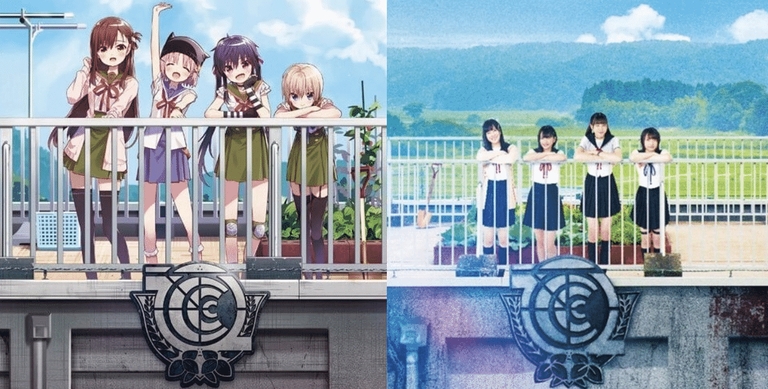
There's a live action movie that came out in 2019. It changes the setting to rural Japan instead of urban. It focuses more on Kurumi's perspective. It handles Megu-nee differently, making her ambiguous in a way that blurs reality and fantasy effectively. But it loses some of the claustrophobia of the anime. The anime works because the school feels like a pressure cooker. The movie feels more open. Both are valid but the anime understands the psychological claustrophobia better.
Gakkou Gurashi explained through its themes and twists comes down to one idea that the show repeats in different ways. Survival isn't killing zombies. Survival is choosing to keep your humanity when the world says you don't have to. The show uses its cute aesthetic as a weapon against despair. It argues that maintaining friendships and routines in the face of horror isn't delusional. It's necessary. The delusion is only dangerous when it stops you from running from a real threat.
The ending isn't happy exactly. They leave the school and head into an uncertain future with backpacks and a car. But it's hopeful. Yuki isn't hallucinating anymore. Kurumi isn't just killing things. They're moving forward as people instead of ghosts. That's what the show was building toward. Not a cure for the zombie virus. A cure for the despair virus that infects people when they give up.
If you skipped this show because it looked too cute or too dark depending on your taste, go back to it. It's smarter than it gets credit for. It understands that the scariest thing in a zombie apocalypse isn't the dead trying to eat you. It's giving up on the living while you're still breathing.
Frequently Asked Questions
What is the twist in Gakkou Gurashi episode 1?
The big twist at the end of episode one reveals that Yuki Takeya is hallucinating a normal school life. The school is actually ruined and barricaded against zombies. Yuki has dissociative disorder from trauma, and the other girls are maintaining her fantasy to keep her functional while they survive the real apocalypse.
What is the Megu-nee twist?
Megu-nee is already dead. Yuki is hallucinating her teacher as a coping mechanism because Megu-nee died saving the girls at the start of the outbreak. The other girls can't see Megu-nee and leave an empty chair for her. Later, the real Megu-nee appears as a zombie in the school basement.
Do the characters represent the five stages of grief?
Yuki represents Denial, Kurumi represents Anger, Miki represents Bargaining, Yuuri represents Depression, and Megu-nee represents Acceptance. Each character embodies a different psychological response to the trauma of the apocalypse.
How does the Gakkou Gurashi manga end?
The manga continues well past the anime ending. The girls reach Saint Isidore University, encounter militant survivor factions, and uncover a conspiracy involving the Randall Corporation and the biological weapon that caused the outbreak. The manga provides more worldbuilding and a bittersweet resolution where they find a natural cure.
Why does Gakkou Gurashi use cute character designs for a horror story?
The contrast between the cute moe art style and the horror elements forces viewers to recognize these are real children facing violence, not action heroes. It mirrors how real trauma happens during normal life activities, not just in dark gritty settings, and makes the violence feel more violating and personal.