Nier Automata Ver1.1a Anime Changes More Lore Than You Realize
People keep calling Ver1.1a a straight adaptation and that is dead wrong. The second you see that version number in the title, you should know this is not just the game with a frame limiter removed. It is a branch. A split. Yoko Taro literally wrote this thing to diverge because he thinks direct adaptations are boring and he tried to destroy the original story during production meetings.
The anime takes the bones of PlatinumGames' 2017 release and snaps them in half, then glues them back together with scenes from stage plays and novels you probably never read. Routes A and B run at the same time instead of sequentially. Characters die in different orders. There is a puppet show at the end of every episode that adapts the game's joke endings. If you are watching this expecting a shot-for-shot remake, you are going to get confused when Lily shows up instead of Anemone and when Adam turns into a kaiju monster that was not in the original code.
I keep seeing posts asking why they changed specific scenes so here is the full breakdown of what got messed with and why it is still considered canon within the Drakengard multiverse framework.
That Version Number Is a Warning Sign
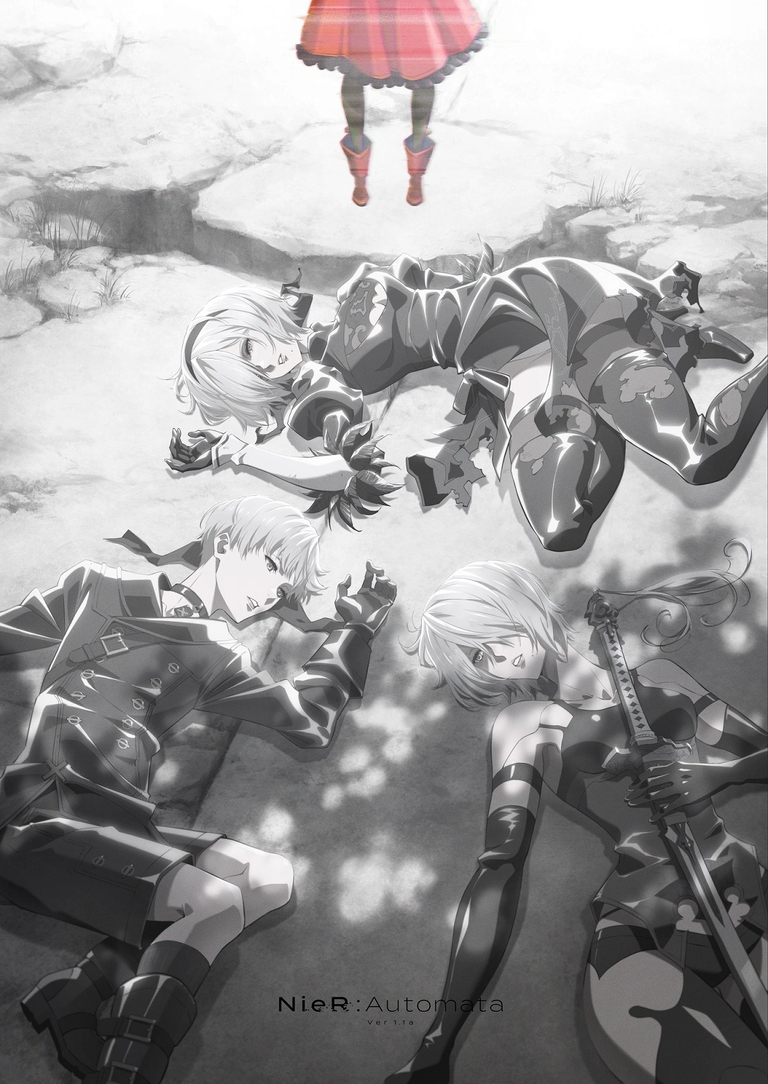
The Ver1.1a is not marketing fluff or a tech demo name. It denotes this is an alternate universe within the established lore. Taro pitched this as a separate timeline from day one because he originally tried to rewrite the entire first episode from scratch and make it unrecognizable. The A-1 Pictures staff had to physically restrain him from turning the anime into something completely different. What we got is the compromise between Taro wanting to burn the script down and the producers wanting recognizable iconography that would sell Blu-rays.
Every change from Lily leading the Resistance to Eve dying before Adam is canon to this branch but not to the game branch. The NieR universe operates on a multiverse system where every possibility exists somewhere. This is not a retcon. It is a what-if scenario that got a budget. When you see Adam transform into that weird Reincarnation-looking monster at the end of the first cour, that is not bad animation. That is a deliberate divergence showing what happens when Eve dies first and Adam loses his philosophical cool.
Routes A and B Got Merged Into a Messy Soup
In the game you play Route A as 2B, then you replay Route B as 9S to see his perspective on the same events with added context. The anime does not have time for that structural repetition. It runs both viewpoints simultaneously, cutting between 2B's combat and 9S's hacking in real time during the same scenes. This kills the repetition theme that defined the game's structure and its commentary on cycles of violence. You lose that crushing feeling of doing the same boss fight twice with different emotional context. Instead you get a linear sequence that hits the plot beats faster but loses the mechanical weight of the original design.
Some scenes show events from angles you never saw in-game, which is neat for lore hunters, but the pacing feels rushed because they are cramming two full playthroughs into one watch. The game made you live through the boredom and repetition to make a point about the characters being trapped in a loop. The anime just tells you the loop exists and moves on. It is a different kind of story because it cannot assume you are holding a controller.

Lily Replaces Anemone and A2 Gets Real Development
The biggest character shuffle that confuses new viewers is that Anemone is dead and Lily leads the Resistance. In the game, Lily died during the Pearl Harbor Descent mission while Anemone survived and became the leader. In Ver1.1a it is flipped. Lily lives, takes command, and gets actual screen time instead of being a footnote in a text log you probably missed. This matters because it changes the emotional anchor for the Resistance camp scenes and makes the later zombie outbreak hit harder because you have spent time with these people.
A2 gets the real upgrade though. In the game she is mysterious until Route C and her backstory is hidden in collectible intel that most players skip. The anime devotes entire episodes to the Pearl Harbor Descent, showing her bond with her squad and Lily before everything went wrong. You see why she deserted. You see the Et tu, Brute namesake moment. She spends time in Pascal's village really developing relationships instead of just showing up to stab things and leave. By the time she fights 2B, you care about her as more than a weird clone with a grudge and a revealing outfit.
The anime also pulls from the YoRHa stage plays and the Pearl Harbor Descent Record manga to flesh out her personality. She is not just angry. She is grieving and guilty and tired. The game hinted at this but the anime shoves it in your face and makes it the emotional core of the second cour.
Adam and Eve Die Backwards and Look Different
In the game, 2B kills Adam in the Copied City after he gets too philosophical. Eve absorbs his body and goes berserk. In Ver1.1a, Eve intervenes during the fight and gets himself killed instead, which sends Adam into a rage spiral that strips away all his pretentious dialogue about human evolution. He transforms into this kaiju-sized monster thing that looks like it crawled out of NieR Reincarnation and the fight happens in a replica of The Library from Route C, which makes no chronological sense but looks cool.
Adam's motivation shifts from philosophical antagonist to grieving brother monster. It changes the final battle entirely and removes the quiet death scene where he accepts his end. Instead he just screams and breaks things. Some fans hate this change because it removes the subtlety. Others like it because it shows what happens when the emotional crutch of the twins is kicked away early. Either way, it is a massive deviation that affects the tone of the entire back half.
Boss Fights and Locations That Disappeared Completely
Grün is gone. That massive ocean Goliath you fight with a missile strike in the Flooded City? Cut entirely. The anime skips the Forest Kingdom, routing you straight from the commercial facility to Pascal's Village without the detour through the castle. The Become as Gods factory sequence becomes Become as Eve and Pascal is not even there. The second Goliath encounter in the city ruins vanishes. These are not just cuts for time. They are replacements with different emotional goals.
Instead of fighting Grün, 2B and 9S investigate A2's history in the Flooded City and dig into her past. The pacing feels weird because the anime is trading spectacle for character moments. You lose the big robot explosions but you gain context for why A2 hates YoRHa Command. For a TV budget, this makes sense. Rendering that water battle in 2D animation would have bankrupted the studio and the CGI they had looked terrible anyway.
The Ending Is Not Ending E
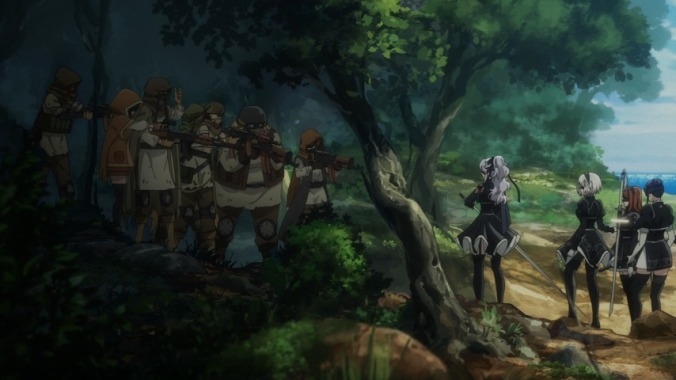
The game has multiple endings. A, B, C, D, and the true Ending E where the Pods rebel against their programming and reconstruct the androids after the Tower collapses. The anime takes pieces of C, D, and E and welds them into something new that does not exist in the game code. A2 fights 9S but resists his hacking attempt through sheer willpower. The machine network offers her a spot on their space ark to escape Earth. The Pods rebel to repair 2B and 9S but die in the process. Accord from Drakengard shows up to fix A2 in a post-credits scene.
It is titled Alternative [E]den for a reason. It is not the game's ending. It is a what-if that lets the characters survive differently and suggests the cycle might actually break this time. The Pods sacrifice themselves completely instead of surviving to rebuild. It is darker in some ways and more hopeful in others. If you watched this expecting the credits roll from the game, you missed that this is a separate branch where different choices were made.
Lore Deep Cuts You Missed
The anime pulls from every corner of the franchise and external media. When 9S hacks Emil, you see Kainé and Yonah from NieR Replicant directly in the memory footage, not just implied references or offhand comments. There is a hidden church in the Copied City that references the Sadfutago mod that drove the fanbase crazy in 2022, complete with architecture that should not exist in this timeline. Devola and Popola show up earlier and actually help the Resistance instead of hiding in the tower until the endgame.
The Red Girls show conflicting consciousness way before they should, hinting at the Drakengard connections earlier. There is even a live-action storybook segment that links back to the first Drag-On Dragoon game. This stuff is buried in the game's text files or external novels like the Long Story Short book, but the anime puts it front and center so casual viewers can see the connections without grinding for intel drops.
Production Woes and Visual Choices
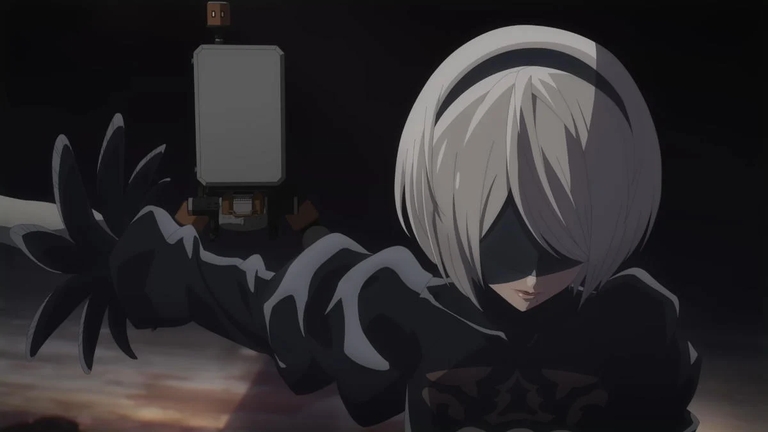
Let's be real about the visuals. The CGI is rough and plastic-looking. The premiere looked like a PS3 cutscene and the schedule collapsed so hard they had to take multiple hiatuses between cours. When it is 2D animation, the camera work is obsessive, recreating the game's framing shot-for-shot. You can overlay the anime and game footage and match the angles perfectly because the director was that dedicated to the aesthetic.
But then a Goliath shows up and it looks like a PS2 model. The puppet theater segments after the credits use stop-motion or simple animations to adapt the game's joke endings, which is clever, but also feels like they ran out of budget for proper animation. The soundtrack is lifted directly from the game though, which helps cover the rough patches.
Yoko Taro explained in interviews that he wanted to change way more than what ended up on screen. He described the process as him trying to destroy the story while the anime staff fought to preserve it. The Ver1.1a suffix was his compromise to signal that changes were coming. The production was troubled by health issues and COVID delays, which shows in the uneven quality, but the ambition is there even when the frames are missing.
Should You Watch It or Play the Game First
If you watch Ver1.1a without touching the game, you are getting a compressed, altered version of a story that relies on interactivity to land its emotional punches. The game makes you complicit in the violence through gameplay mechanics that force you to shoot and slash repeatedly. The anime just shows it to you from a distance. You lose the impact of the bullet hell sections and the hacking minigames that break up the pacing.
That said, if you have played the game, the anime is worth watching for the Pearl Harbor Descent episodes and the alternate ending alone. It is a companion piece, not a replacement. Think of it like the manga adaptations that change the ending to explore different themes. It exists because Yoko Taro gets bored and wants to see what happens if he breaks his own toys in a different timeline.
The anime also adapts lore from the YoRHa stage play and the Dark Apocalypse raid from Final Fantasy XIV, stuff that most game players never saw. So in some ways it is more complete than the game, even while it skips boss fights. It is messy and confusing and sometimes ugly, but it is different on purpose. That is what the 1.1a means. It is not trying to be the game. It is trying to be the game gone wrong in interesting ways.
Ver1.1a is not trying to replace the 2017 release. It cannot. The game is built on player agency and repetition that does not translate to passive viewing. What the anime does is expand the branches. It gives A2 a soul. It lets Lily live. It shows us what happens when the Pods choose differently and sacrifice themselves completely. The changes are not mistakes or budget cuts. They are the whole point of the version number.
If you want the real story, play Route A through E on hard mode and read all the intel files. If you want to see Yoko Taro play with alternate timelines and steal scenes from stage plays that were only performed in Japan, watch the anime. Just do not complain when Adam turns into a monster or when the Resistance leader has a different name. That is what you signed up for when you clicked on episode one.
Frequently Asked Questions
Is the Nier Automata anime a direct adaptation of the game?
No. The Ver1.1a designation indicates it is an alternate timeline within the Drakengard/NieR multiverse. While it shares the setup, major plot points like character deaths, the order of bosses, and the ending are changed to create a different branch of the story.
What are the biggest differences between the anime and the game?
The anime merges Routes A and B into a simultaneous narrative rather than sequential playthroughs. It also changes key events like Lily surviving instead of Anemone, Eve dying before Adam, and adds an original ending blending elements from the game's Routes C, D, and E.
How does the anime handle A2 differently?
The anime significantly expands her role using material from the YoRHa stage play and Pearl Harbor Descent Record. It shows her past with Lily and her squad in detail, making her betrayal by YoRHa Command and her survivor guilt central to the plot rather than hidden in text logs.
Why did Yoko Taro change the story for the anime?
Originally Taro wanted to rewrite the story completely because he felt a direct adaptation would be boring. The anime staff convinced him to keep the core structure, but the Ver1.1a title was added to signal that this is a diverging timeline with his blessing.
Should I watch the anime or play the game first?
Play the game first. The anime assumes familiarity with the characters and skips emotional beats that rely on gameplay mechanics. It works best as a companion piece for fans who want to see alternate timeline lore and expanded backstories.