
Sakura Trick Anime Kiss Scenes Analysis And The Frequency Trap
Sakura Trick anime kiss scenes analysis starts with a number that breaks most romance shows. 4.8. That's roughly how many times Haruka and Yuu lock lips per episode across twelve episodes, not counting the opening credits or promotional art. Most romance anime teases a kiss for twenty-two episodes and then cuts to fireworks or a cherry blossom freeze-frame. This show treats mouth-to-mouth contact like a punctuation mark.
But here's the weird part. After episode six, you stop noticing. The kisses become like background radiation. Cute, pink, radiation. The show created a kissing quota so aggressive that it accidentally proved something backwards about intimacy. When you pack that many smooch sessions into a twenty-four minute runtime, you don't get romance. You get a gag reflex.
I saw some data that said Sakura Trick features a high frequency of kiss scenes, with estimates suggesting at least ten kiss scenes for every major scene lacking one in comparable series. That sounds made up until you actually count. Episode three alone has three distinct make-out sessions between Haruka Takayama and Yuu Sonoda, two of which happen in a classroom full of students who apparently lost their peripheral vision.
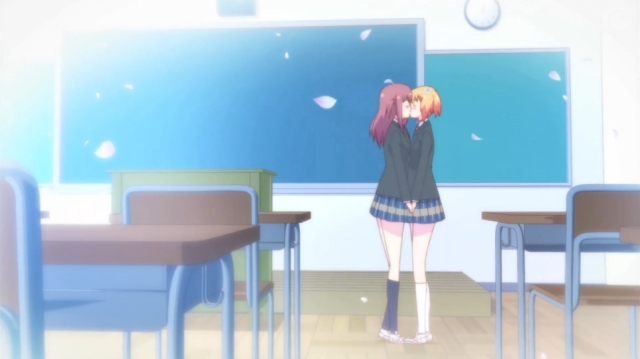
The Kissing Quota Is Real And It Gets Weird
Studio DEEN didn't stumble into this frequency by accident. Watch the episode structure. There's always a setup, a misunderstanding about friendship boundaries, and then a kiss to resolve the tension. Every single time. By episode four you can set your watch to it. Some fans call it the kissing quota, like the writers had a checklist. One review noted that this quota served as a distraction, a constraint to get the show greenlit in a less profitable genre rather than a malicious element, but still formulaic.
The problem isn't that they kiss. It's that the kisses replace conversation. Haruka and Yuu start as childhood friends who panic about being separated in high school. Their solution is physical escalation. First episode, vacant classroom, sakura petals floating around them. That first kiss hits hard. It's soft, awkward, and framed like a secret. Then they keep doing it. In the student council room. Behind the gym. During lunch. In front of windows. The show establishes a close friendship early but then stalls there, substituting saliva for character growth.
Yuu spends half the series worrying about someone finding out. Then she stops worrying. The stakes evaporate. You get scenes where they kiss in public spaces and nobody reacts, which some defenders say is a deliberate comedic element where other characters likely already know, but it plays more like the universe hit the mute button on consequences.
The animation style attempts to emulate Shaft's aesthetic from Hidamari Sketch, which makes sense given that director Kenichi Ishikura worked on that series. Studio DEEN uses bright colors and soft textures. It looks good. Possibly the best looking DEEN production. But the visual appeal can't fix the repetitive nature of the gags. Episode five subverts slice of life tropes by quickly resolving a secret-keeping gag instead of dragging it out. It skips cliched cultural festival mishaps. But the kisses still come like clockwork. The show adheres to an actual story arc with consequences, which is rare for the genre, but then undercuts itself with the quota.
Episode Nine Proves The Rule
Then you hit episode nine. Suddenly, no kisses. Well, one accidental forehead bump that gets treated like a tragedy. This episode is weirdly brilliant because it proves the show works better when the characters aren't eating each other's faces. Haruka gets sick. Yuu panics about being apart. There's actual tension about separation and identity without the lip service.
Fans noticed this. One discussion pointed out that specific episodes featured minimal or no on-screen kisses, with one instance being an accidental forehead kiss between Haruka and Yuu. That absence hurt. That absence felt like real intimacy. When you withhold the thing you've been spamming, the viewer suddenly remembers these are two people with attachment issues, not kissing machines.
The episode nine phenomenon exposes the trap. When kisses are rare, they matter. When they're constant, they're noise. Sakura Trick accidentally trained its audience to view affection as a tick-box exercise, then episode nine reminded everyone what actual longing looks like.
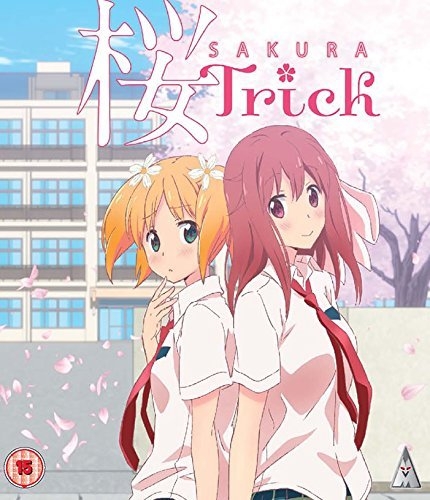
Sound Design And The ASMR Trap
Listen closely to the audio mix. Most kisses get that close-mic chuu sound, almost whisper level. It's an instant ear tickle. The sound design keeps the kisses intimate even when the context makes no sense. Characters talking in the hallway continue discussing tests or lunch right over the kiss audio. That contrast creates a split-second cocoon. Their world keeps spinning while time stops for them.
The music by Ryosuke Nakanishi is simple and competent. It induces joy on cue. But paired with the kissing sounds, it creates a Pavlovian response. You hear the soft piano, you see the pastel colors, you know the kiss is coming. By episode eight, the response fades. You need increasingly absurd scenarios to get the same reaction, which explains why later episodes feature kisses to check if someone is okay after a fall or to hide from a teacher.
They use background chatter as a technique. If you watch with subs you will notice hallway NPCs keep talking about mundane school stuff right over the kiss audio. That contrast is the point. But when every episode uses the same trick, you stop noticing. You are inside the bubble too. The intimacy becomes insulation rather than connection.
Haruka's Impulse Versus Yuu's Uncertainty
Let's talk about the main couple. Haruka operates on pure impulse. She sees Yuu, she wants to kiss Yuu, she does it. No logic, just desire. Yuu is all uncertainty and deflection. She keeps Haruka at arm's length while simultaneously initiating kisses when she feels insecure. It's a mess.
One analysis described Haruka as impulse and Yuu as uncertainty. Haruka struggles with self-image, constantly apologizing for wanting things. She is obsessive over her best friend, which helps her overcome personal barriers. Yuu uses physical affection as emotional armor. When Haruka recoils from a kiss in episode eight, Yuu gets hurt because Haruka is her rock. But in the finale, Yuu insistently kisses Haruka despite protests, acting pushy. The relationship is lopsided. Yuu takes advantage of Haruka's obsessive nature while pretending to be the cautious one.
This dynamic makes the kiss scenes feel less romantic and more like a power struggle. Haruka kisses to confirm possession. Yuu kisses to confirm security. Neither is really connecting. They're just pressing buttons to get dopamine hits. The Head Haruka sequences, representing her internal fantasies, got toned down after the initial episodes. This shows the show itself backing away from its own intensity.
Mitsuki Steals The Show
While Haruka and Yuu are busy swapping spit in supply closets, Mitsuki Sonoda (Yuu's older sister) is having an actual character arc. She starts as the antagonist trying to block the relationship. Then she realizes she's jealous because she's closeted and self-hating. Her interest in Haruka becomes clear as jealous rivalry. She uses Haruka as an outlet for pent-up emotions, having had no close friends prior.
Mitsuki represents ascension. She accepts her feelings as fate, approaches love like a problem to be solved, and backs away when Haruka's answer differs. Her struggle highlights that love doesn't fit in boxes. By the end, she's emotionally surpassed both leads despite getting crushed by her decision. She gets maybe three kisses total, all painful, all meaningful.
Compare that to Haruka and Yuu's forty-plus kisses that blur together into pink static. Mitsuki's arc proves that restraint creates better romance than frequency. Her impending graduation adds a sense of time pressure, leading her to accept her identity and emotionally surpass Haruka, though crushed by her decision.
Kotone And Shizuku Have The Real Romance
Kotone and Shizuku steal the show because their relationship has an expiration date. Kotone's parents arranged her marriage. She has to leave. This creates tension that can't be solved by kissing harder. Shizuku starts as a loner who melts slowly, pushing past her comfort zone. Kotone acts like a chess-master, guiding situations but hiding her intellect behind a goofy facade.
One review highlighted that this background relationship has strong potential that is unfortunately squandered and rarely explored, believing that applying such conflict to Yuu and Haruka would have greatly improved the series. When Kotone and Shizuku kiss, it feels desperate. Like they're stealing time. When Haruka and Yuu kiss, it feels like they're killing time.
Kotone's arranged marriage represents the looming adultness that will take away her personal choice. This makes her relationship with Shizuku precarious and finite. That's real stakes. That's why their fewer kisses carry more weight than the main couple's entire catalog. Shizuku's theme is melting from anti-social isolation to friendship and fear of failure. She believes Kotone controls their relationship. Her insecurity mirrors real relationship dynamics. Episode ten where she laments the finite nature of the relationship due to arranged marriage hits harder than any of the main couple's public make-outs.
Fan Service Or Just Service
Here's the argument that splits the community. Some say Sakura Trick is revolutionary because it shows two girls kissing without tragic music or deathbed confessions. One Reddit user argued that the series poignantly explores the struggle of characters navigating a relationship they believe is socially unacceptable, while establishing the central romantic relationship in the first episode and avoiding the ambiguous ending trope found in other series.
Others say it's just porn plot substituting kissing for sex. The characters make out to check if someone is okay after a fall. They kiss to hide from teachers. They kiss because the room is too hot. The reasoning gets flimsy. The camera stays mostly static and eye-level, avoiding ecchi pans, which suggests the director wanted to show these two being dorks rather than check the tongue angle. But the frequency undermines that artistic intent. It starts feeling like a conveyor belt.
Some early reviews felt it catered to ignorant male fantasies with fanservice-heavy openings. Others argue it's for the yuri demographic regardless of gender. The lack of explicit fetish content compared to typical ecchi suggests it isn't just for straight male viewers, but the kissing quota feels like it is checking boxes for a specific audience.
Why First Time Viewers Loved It
Context matters. In 2014, this hit different. Yuri anime usually ended in tragedy or ambiguous hand-holding. Seeing two girls just kiss without dying of tuberculosis or getting hit by a car felt revolutionary. The show served as a first yuri anime for many viewers, setting a high standard due to its fluffy, cute, and fluttery kisses.
First time viewers didn't notice the quota because they were too busy being shocked that the girls actually kissed. Repeatedly. In public. It felt like progress. It felt like normalization. The concept of an entire episode being dedicated to a single kissing scene was mentioned and appreciated. The famous yuri physics scene where gravity bends to facilitate romance became a meme.
But rewatching now, the quota thing is obvious and kinda cringe. The novelty wore off. You start noticing that Yuu says what if people find out once and then never worries again. You start noticing that the side characters Yuzu and Kaede serve as everyman commentators on the Yuri genre but don't actually impact the plot.
How It Compares To Actual Romance Anime
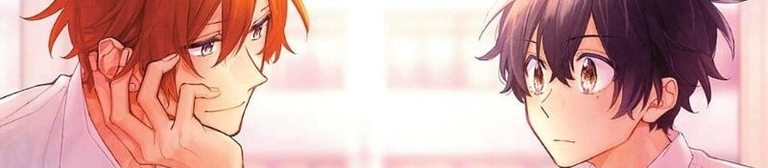
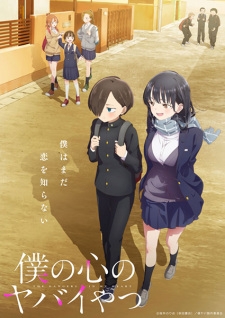
Look at Adachi and Shimamura or Sasaki and Miyano. These shows understand that longing is more powerful than satisfaction. Adachi spends episodes agonizing over hand-holding. Sasaki takes a full cour just to confess. They build tension through restraint.
Sakura Trick spends its tension in the first episode. Then it's just maintenance mode. Compared to Strawberry Panic, which has dramatic buildup and social consequences, Sakura Trick feels like a sandbox where actions have no reactions. The girls kiss in public and nobody cares. That might be a fantasy of acceptance, but it removes the conflict that makes romance stories work.
Even Yuru Yuri, which is pure comedy, keeps its romantic tension ambiguous and therefore sustainable. Sakura Trick burns through its premise in six episodes then spins wheels for six more. The show was chosen over other series like Strawberry Panic due to its focus and accessibility of romantic scenes, but that accessibility comes at the cost of dramatic weight.
The Verdict On Sakura Trick Anime Kiss Scenes Analysis
Sakura Trick anime kiss scenes analysis comes down to this. The show wanted to normalize yuri relationships by making them cute and frequent. It succeeded in making them frequent. The normalization part failed because it removed all obstacles. Without obstacles, you don't have a story. You have a screensaver.
Episode nine proved the writers could do better. The side couples proved they understood stakes. But the main pair got stuck in a loop of oops we kissed again gags that stopped being funny by the halfway mark. The kisses are well-animated. The sound design is clever. The characters are likable enough. But the Sakura Trick anime kiss scenes analysis reveals a trap. When intimacy becomes routine, it stops being intimate. It becomes punctuation. And nobody gets excited about a comma.
If you want to see what high-frequency kissing looks like when it works, this is the case study. If you want to see why restraint matters in romance writing, this is also the case study. It's both a success and a cautionary tale. Watch it for Mitsuki. Watch it for Kotone and Shizuku. Maybe skip to episode nine if you want to see what the show could have been without the quota breathing down its neck.
Frequently Asked Questions
How many times do Haruka and Yuu kiss in Sakura Trick?
They kiss approximately 4.8 times per episode on average, totaling over fifty kisses across the twelve episode series. Episode nine is the exception with only an accidental forehead kiss.
Why don't people notice them kissing in public?
The public kisses use background noise and static camera angles to create a bubble effect. Other characters often don't react because they either don't see or already know, serving as a fantasy insulation where the girls can be intimate without social consequences.
Is Sakura Trick worth watching?
Depends on your tolerance for repetition. First time viewers in 2014 found it revolutionary for showing yuri intimacy without tragedy. Rewatching reveals the kissing quota makes the romance feel formulaic after episode six. Watch it for the side characters Mitsuki and Kotone/Shizuku.
Is Sakura Trick fan service for men?
Opinions vary. The camera avoids typical ecchi angles and the show focuses on emotional connections, suggesting it serves the yuri demographic. However, the high frequency of kissing scenes and fanservice elements in the opening led some early critics to feel it catered to male fantasies.
Who is the best couple in Sakura Trick?
Kotone and Shizuku have a more compelling arc involving an arranged marriage that creates real stakes. Mitsuki Sonoda (Yuu's sister) undergoes genuine character growth from antagonist to tragic third wheel with closeted feelings. Both pairs have better development than the main couple.