
School-Live! Anime Psychological Horror Analysis
You think you're watching another trash moe show about high school girls drinking tea and wearing dumb hats. Then the camera pulls back and you realize you've been tricked. That's the whole point. School-Live! anime psychological horror analysis isn't about finding jump scares or counting body parts. It's about how the show forces you to question what you're seeing and why your brain wants to believe the lie.
The first episode is a dirty trick and I mean that as a compliment. Lerche knew exactly what they were doing when they animated twenty minutes of Yuki Takeya running around like an idiot, talking to teachers who aren't there, and acting like the bloodstains on the windows are just dirt. They wanted you comfortable. They wanted you annoyed by the high-pitched voices and the stupid gags. Then they pull the rug out and show you the bars on the windows, the pile of desks blocking the door, and the fact that this cheerful schoolgirl is talking to a corpse.
This isn't just a gimmick where cute girls meet zombies. The horror comes from the slow realization that Yuki isn't playing pretend for fun. Her mind snapped like a dry twig when the world ended, and now she lives in a fantasy where Megu-nee is still alive and the School Living Club is just a fun after-school activity. The other girls play along because they need her delusion as much as she does. It's messed up and it's brilliant.

The First Episode Lie
Most horror anime telegraph their punches. You get ominous music, dark lighting, maybe someone mentions a curse in the first five minutes. School-Live! doesn't do that. It commits to the bit so hard that some viewers on Reddit admitted they dropped the show halfway through the pilot because they thought it was just another Kirara fluff piece. They missed the twist because the show never winks at you. It never drops the mask until Yuki walks past a broken window and the wind blows through the shattered glass, and even then you might not catch it if you aren't paying attention.
The direction uses color saturation like a weapon. When Yuki is in her fantasy world, everything is bright and overexposed, like an Instagram filter from 2012. When the camera switches to Miki or Kurumi's perspective, the colors drain out and you see the gray reality of a school that's falling apart. Lerche didn't just adapt a manga here, they built a visual language that lies to your eyes. According to one analysis, this technique creates an unreliable narrator effect where the viewer is gaslit alongside the characters.
The sound design plays dirty too. In Yuki's fantasy, you hear chatter in the halls, bells ringing, normal school sounds. In reality, there's just wind and the occasional distant moan. The show makes you work for the truth. You have to notice that the background students don't cast shadows, or that the teacher never interacts with objects. It's a test of observation that most viewers fail on first watch, which makes the reveal hit like a truck.

Yuki's Broken Mind Isn't Cute
People call Yuki's condition psychosis or PTSD-induced delusion, but those are just fancy doctor words for a defense mechanism that kept her from swallowing a bullet. When the outbreak happened and Megu-nee died in front of her, Yuki's brain checked out. She didn't just forget the trauma, she rebuilt the entire world in her head to exclude it. That's why she sees zombies as classmates asking for help. That's why she still attends classes that don't exist.
The scary part isn't that she's crazy. The scary part is how functional she is. Yuki's delusion isn't random, it's targeted. She filters out the horror so the other girls can use her "school outings" as cover to scavenge for supplies. She's like a human radar jammer for despair. One article explains that her condition creates a weird feedback loop where the other characters find comfort in her fantasy. They get to pretend for a few hours that the world didn't end because Yuki never got the memo.
But delusions crack. In episode 10 when the zombies break through the barricades and destroy the classroom, Yuki doesn't just snap out of it. She integrates the horror into her fantasy, treating the undead invasion like a surprise party or a gym class activity. It's only when she's forced to choose between her fake friends and her real ones that she starts to wake up. Her arc isn't about curing her madness, it's about learning that pretending doesn't save anyone.
Yuki's character journey shows that her hallucinations serve a purpose. They keep the group together. When she finally accepts that Megu-nee is dead, it's not a victory. It's a loss of the last safe place she had. The show treats her mental break with respect, not as a joke, which makes it hit harder than standard horror tropes.
The Club as a Survival Tool
The School Living Club sounds like a made-up excuse to hang out after school, and it is, but it's also the only thing keeping these kids from eating a gun. Yuuri, Kurumi, and Miki aren't just humoring Yuki because they're nice. They've built an entire social structure around her delusion because without it, they'd have to face the fact that they're four teenagers waiting to die in a concrete box.
Yuuri plays the mother figure, Kurumi plays the warrior, Miki plays the doubter, and Yuki plays the mascot. These roles give them purpose. When Kurumi goes out to bash zombie heads with her shovel, she's not just gathering supplies, she's performing the role of protector so the others feel safe enough to sleep at night. The club activities, the meetings, the stupid rules about sleeping in classrooms, it's all theater. But it's theater that keeps the blood pumping.
This is where the psychological horror gets deeper than the zombie gore. The show asks what happens when your coping mechanism becomes your prison. The girls could leave the school, theoretically. There are other survivors, other buildings, maybe even safe zones. But they stay because the School Living Club is the only identity they have left. Leaving the school would mean graduating from their delusion, and none of them are ready for that.
Miki initially hates the setup. She thinks they're enabling Yuki's sickness by playing along. But after spending time with the group, she realizes that forcing Yuki to face reality might kill her, and maybe the rest of them too. The club becomes a conspiracy of kindness, a shared lie that keeps them human. That's messed up when you think about it, but it works.
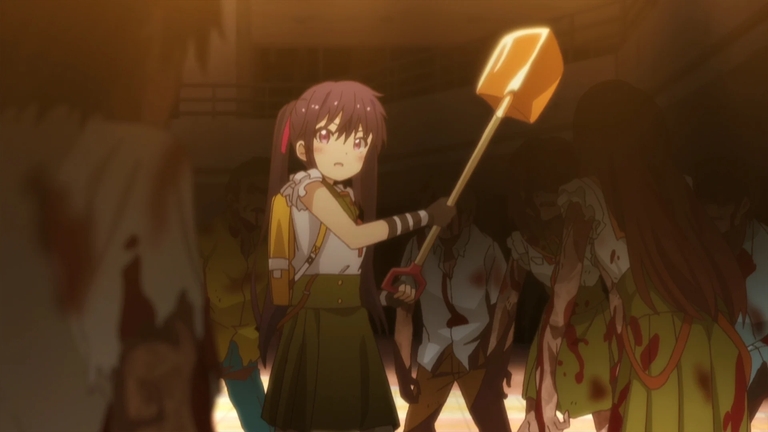
Kurumi and the Violence of Living
Kurumi Ebisuzawa carries a shovel everywhere and talks to it like it's a person. That should tell you everything about her mental state. Before the outbreak, she was a normal high school girl with a crush on an upperclassman. After he turned into a zombie and she had to kill him with a shovel, she became something else. She doesn't just fight zombies, she stops seeing them as people on purpose. She covers their faces with her cap or looks away when she swings because if she recognizes them, she freezes.
The anime adds a scene where she finds a zombie wearing her boyfriend's school uniform and you can see her hands shake. She doesn't cry or scream, she just keeps hitting until the thing stops moving. Then she goes back to the clubroom and pretends she's fine. This is what trauma looks like when you don't have time to process it. Kurumi is functional but she's hanging on by a thread, and everyone knows it. When she gets bitten later in the series, it's almost a relief for her. Finally, a break from the constant watching and guarding.
Her shovel isn't just a weapon. It's a reminder of the first person she killed. She keeps it clean, she names it, she treats it like a friend because acknowledging that it's a tool for murder would break her. The show uses her to explore how violence changes you. Kurumi isn't a badass action hero. She's a scared kid who learned that swinging first is the only way to keep from crying.

Why the Moe Art Style Makes It Worse
The character designs in School-Live! are super cute. Big eyes, soft lines, pastel colors, the whole nine yards. This isn't an accident. If this show looked like Attack on Titan or Highschool of the Dead, with gritty lines and shadows everywhere, the horror would be skin-deep. You'd see the zombies coming and you'd brace for impact. But when the characters look like they belong in a music video about pudding, the horror hits different.
Your brain is trained to associate these visuals with safety. When you see Yuki's stupid cat-ear hat and her big pink hair, you relax. Then the camera pans to show a zombie with its jaw hanging off standing right behind her, and your lizard brain screams because the signals don't match. This clash is what makes the show genuinely upsetting. It's not just scary, it's wrong.
The live-action movie failed because real people can't pull off moe aesthetics without looking like they're in a bad commercial. The anime gets away with it because animated girls with eyes the size of dinner plates create a buffer of unreality that makes the violence shocking when it breaks through. The cuteness isn't just a contrast, it's a trap.
The Megu-nee Problem
Megumi Sakura is dead from episode one, but she gets more screen time than some living characters. Yuki sees her as the club advisor, the responsible adult who will fix everything. The other girls see her as a ghost, a reminder of their failure to protect their teacher. The audience sees her as a measure of Yuki's mental health. When Yuki talks to Megu-nee, she's really talking to the part of herself that knows the truth but can't handle it.
The reveal that Megu-nee is a hallucination hits hard because the show lets you believe it for so long. You think maybe she's hiding, maybe she's trapped somewhere, maybe there's a rescue coming. Then you see the flashback where Megu-nee got bitten saving the girls, and you realize you've been watching a ghost story disguised as a survival tale. Yuki's character arc depends on letting go of Megu-nee, which means accepting that the adults are dead and the kids are on their own.
The other girls maintain the fiction by leaving an empty chair for Megu-nee or responding when Yuki asks what "Megu-nee" thinks. They're not just protecting Yuki, they're protecting the last bit of authority they had. Once Megu-nee is truly gone, they have to admit they're orphans making it up as they go.

Reality Always Wins
By the final episodes, the school is breached, the supplies are running out, and Yuki can't pretend anymore. The graduation ceremony they hold isn't just a cute send-off, it's a funeral for their childhood. They're leaving the only safe place they know, and they're doing it without the protective lens of Yuki's delusion to soften the blow.
The ending isn't happy, not really. They escape the school, sure, but they're walking into a world that's still dead. The difference is that now they're facing it with eyes open. Yuki takes off her cat-ear hat, the one she wore to stay in her fantasy world, and she doesn't put it back on. That's the real horror of School-Live!, not the zombies or the blood, but the moment when you realize that living means accepting the pain you were trying to escape.
The show works because it understands that psychological survival is just as hard as physical survival. You can have food, water, and weapons, but if your mind breaks, you're already dead. The School Living Club survived because they lied to each other, and they kept living because they eventually stopped. That's the core of School-Live! anime psychological horror analysis. It's not about the monsters outside. It's about the monsters we create in our heads to keep going, and the courage it takes to kill them.
Frequently Asked Questions
Is School-Live! actually scary or just a slice of life anime?
It starts as slice of life but becomes genuinely scary psychological horror. The first episode tricks you into thinking it's cute girls doing cute things, then reveals a zombie apocalypse where the main character is delusional. The horror comes from the mental breakdowns and the constant threat of the undead, not just jump scares.
What's wrong with Yuki Takeya's mental state?
Yuki suffers from severe PTSD-induced psychosis. When her teacher died during the outbreak, her mind created a delusion that everything was normal to protect her from the trauma. She hallucinates that dead characters are still alive and can't perceive the zombies as threats. It's a coping mechanism that keeps her functional but disconnected from reality.
Why do the other girls play along with Yuki's delusions?
They need her fantasy as much as she does. Yuki's cheerful delusion gives the group a reason to keep going and provides emotional relief from the constant horror. They use her 'school outings' as cover to scavenge for supplies, and her happiness reminds them what they're fighting to protect.
Is Megu-nee really dead the whole time?
Yes. Megumi Sakura died saving the girls during the initial outbreak. Yuki hallucinates her presence throughout the series as a way to maintain the fiction that the School Living Club is just a normal after-school activity. The other girls can see that Yuki is talking to empty space, but they maintain the lie to protect her sanity.
How does the anime differ from the manga?
The anime focuses heavily on the psychological horror and Yuki's delusions, while the manga goes deeper into the conspiracy behind the outbreak and introduces more survivor groups later. The anime also expands the role of Taroumaru the dog and adds scenes that emphasize Kurumi's trauma, which were less detailed in the original manga.