
Tamako Market and Tamako Love Story Analysis Reveals a Course Correction
Most people who watched Tamako Market walked away thinking it was just another cute-girls-doing-cute-things show with a weird bird messing everything up. They're not wrong, but they're missing the point of why Tamako Love Story hits so hard when you view them back-to-back. This Tamako Market and Tamako Love Story analysis isn't about praising Kyoto Animation just because they made it look pretty. It's about recognizing how the movie completely rewrites what the series was trying to accomplish, ditching the talking bird comedy for actual emotional stakes that matter.
The series spends twelve episodes floating around the Usagiyama Shopping District with zero urgency. Dera Mochimazzui eats mochi, gets fat, and somehow projects images while everyone smiles and nothing changes. Then the movie drops and suddenly we're dealing with graduation, unspoken crushes, and the terrifying reality that childhood can't last forever. That's not a sequel, that's a correction.
Why Dera Had to Disappear
The talking bird was the worst part of the series and everyone knows it. He was supposed to be the hook, some foreign prince's pet looking for a bride, but he just became a lazy plot device who ate too much and made weird comments about breast-shaped mochi. In the movie, he's gone for almost the entire runtime except for a short opening gag, and the story immediately gets better.
Getting rid of Dera shifts the focus from quirky comedy to the actual humans living in the shopping district. The movie doesn't need a magical projector bird to create conflict because real life already has enough of that when you're seventeen and facing graduation. Apparently, the director Naoko Yamada realized that the bird was holding back the real story about Tamako and Mochizou, which makes you wonder why he was there in the first place. Some fans argue he represented the outside world intruding on the closed community, but that reading doesn't justify how annoying he was in practice. The fortune-telling gimmick he picked up halfway through the series went nowhere, and his weight gain jokes got old fast.
The Romance That Couldn't Breathe in the Series
Mochizou Ooji spent the entire TV series filming things with his camera and never saying what he felt. The movie fixes this by having him finally confess to Tamako before he leaves for Tokyo, and the fallout is messy in a way that feels true to real teenagers who don't know what they're doing. Tamako doesn't immediately reciprocate with some big speech. She runs away, she avoids him, she acts like a confused kid because that's exactly what she is.
This Tamako Market and Tamako Love Story analysis has to point out that the movie works because it stops treating romance like a joke. In the series, Midori prevents Mochizou's confession attempt through Dera because she's jealous, and nothing goes anywhere. The movie treats that same attraction as serious business with consequences. When Tamako is spiraling about the confession, the movie lets her spiral for a solid twenty minutes of screen time, which some people call slow pacing but I call accurate. When she finally chases after Mochizou at the train station using that cup-and-string telephone thing from their childhood, it lands because we spent eighty minutes watching her panic about change, not because some magical bird forced a resolution.
How the Visuals Tell Different Stories
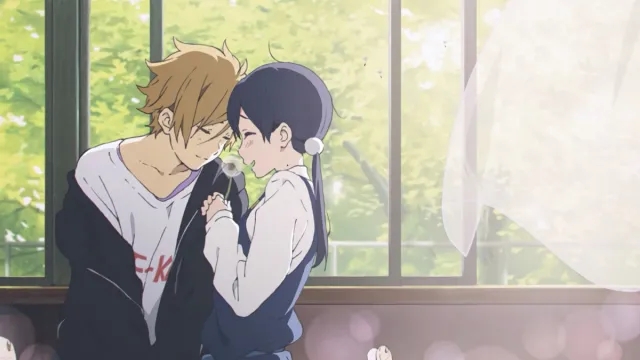
Kyoto Animation didn't just change the writing between the series and the movie, they completely swapped how the thing looks and sounds. The series uses bright brass band music and xylophone ditties that bounce around like everything is fun and nothing hurts. The movie switches to lonely piano melodies and washes everything in this old-camera filter that blurs the edges and makes the colors look faded, like you're watching a memory instead of real life.
The shopping district in the series is loud and chaotic, packed with weird shop owners and festivals and Dera flying into walls. In the movie, those same streets feel quiet and empty, emphasizing how much Tamako is going to lose when everyone graduates and scatters. I saw some data that said the Blu-ray encode averages 40 MB/s which explains why the gradation looks so smooth, but the real trick is the color grading. They made the sky look like deep ocean and the sunsets look like flesh tones, creating this endless summer vibe that hurts because you know it has to end. The film also uses visual separation between Tamako and Mochizou constantly, putting them on opposite sides of the river, shooting them through doorframes, using the male and female bath entrance signs to emphasize the distance between them even when they're close.
Midori Gets the Short End of the Stick
Here's where the movie messes up. In the series, Midori Tokiwa has this beautiful moment where she realizes she has feelings for Tamako too, and it's handled with surprising care for a 2013 anime. The movie throws all of that away because it needs to focus on the straight romance between Tamako and Mochizou. Midori becomes weirdly spiteful toward Mochizou for no good reason, and her arc just fizzles out.
This is the one thing the series did better than the film. The Reddit essay about the family dynamics mentions how the series handled multiple emotional threads at once, while the movie narrows its focus so much that it cuts off interesting side paths. Midori's jealousy in the series was complicated and human. In the movie, she's reduced to a cheerleader who occasionally throws shade. That's a waste of a solid character who deserved better than to just push Tamako toward the guy.
The Mochi Trap
Tamako's family runs a mochi shop, and that business represents everything that holds her back. Her dad Mamedai is stuck in the past, still grieving for his dead wife Hinako, using the traditional shop as a way to avoid moving forward. The series touches on this when Tamako sings "Koi no Uta," the song her dad wrote for her mom, and he breaks down crying. The movie pushes this further by showing how Tamako thinks she has to inherit the shop because that's just what you do, even if it means staying in this district forever while Mochizou goes to Tokyo.
The baton club scenes in the movie aren't just cute animation displays, they're about Tamako learning to catch something instead of just standing there. She drops the baton repeatedly early in the film, just like she drops the cup-and-string phone Mochizou tries to hand her. When she finally catches that phone at the end, it means she's ready to grab her future instead of letting it drift by. The mochi isn't just food, it's comfort that keeps you fat and happy like Dera, too bloated to move on. Tamako's dad has been eating that comfort for years and it made him afraid of new mochi flavors, afraid of remarrying, afraid of anything that changes the routine that keeps his wife's memory frozen in place.
Anko's Quiet Victory
Everyone talks about Tamako and Mochizou, but Anko Kitashirakawa has the best arc across both works. In the series, she's avoiding the mochi shop because it reminds her of the mom she barely remembers. She has this whole subplot about her first crush and wearing glasses that her mom used to fix. By the movie, she's made peace with her memories, and you can see it in how she helps with the shop without being asked.
The ChaosTangent review pointed out how Anko reenacts a memory of her mom helping with her festival outfit, and instead of it being sad, it's invigorating. That's growth that doesn't involve romance, just a kid figuring out how to live with loss. The movie gives her one scene where she basically tells Tamako to stop being stupid about Mochizou, and it's the most mature dialogue in the entire film. She's the one who pushes her sister to act because she recognizes the same avoidance patterns she used to have about their mother's death.
Kanna Steals Every Scene She's In
Kanna Makino loves angles and architecture and makes weird comments about how people's butts look like rice cakes. She's the best character in both the series and the movie because she doesn't change. While everyone else is freaking out about graduation and feelings, Kanna is just there, being odd, building things, making deadpan observations that cut through the melodrama.
The movie knows she's the comic relief that actually works, unlike Dera. When Tamako is spiraling about the confession, Kanna is the one who gives practical advice while also saying something bizarre about carpentry. She's the only character who doesn't get dragged down by the angst because she approaches life like a builder: find the problem, measure it, fix it. We needed way more of her and way less of the bird. Her obsession with right angles and structural integrity becomes a metaphor for her emotional stability while everyone else is falling apart.
Why the Shopping District Fades Away
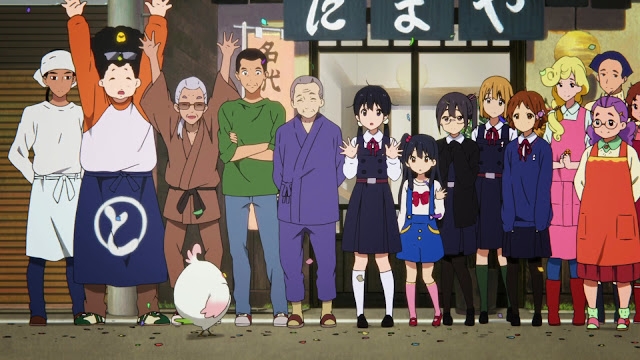
The series made the Usagiyama Shopping District feel like a living organism, with all the shop owners having their own quirks and relationships. The Josh Stevens review notes how the movie pushes all of that to the background because it's not about the community anymore, it's about Tamako as an individual making a choice. Some fans hate this shift, arguing that the series was about how no one is an island, while the movie isolates Tamako with her feelings.
That's a fair criticism, but it misses that the isolation is the point. When you're seventeen and facing the end of high school, the world narrows down to that one person you can't stop thinking about. The district is still there, but Tamako isn't looking at it anymore. She's looking at Mochizou, or herself, or that string telephone. The community that defined the series becomes the safety net she's afraid to leave, which is way more interesting than another episode about Dera getting stuck in a window. The movie treats the district like a ghost town because that's how Tamako sees it once she realizes everyone is leaving.
The Soundtrack Tells You What Genre You're In
Listen to the opening of any Tamako Market episode and you get this bouncy brass band stuff that screams "nothing bad will happen here, just relax." The movie's soundtrack is mostly solo piano and ambient noise, and it creates this heavy feeling in your chest that something is ending. That's not just a change in composers or budget, it's a signal that we've left the slice-of-life genre and entered romance drama territory.
The middle section of the movie, where Tamako is avoiding Mochizou, uses these slow repetitive piano notes that make you feel the awkwardness. It drags intentionally because that's how time moves when you're waiting for someone to text you back or wondering if you messed everything up. The series had insert songs about mochi and happy days. The movie has silence broken only by train sounds and cicadas, which fits the "endless summer" vibe that feels suffocating instead of liberating.
The Confession Scene Actually Matters
In most anime, the confession happens at the end as a reward for the audience. In Tamako Love Story, it happens in the middle, and the rest of the movie is about dealing with the aftermath. Mochizou drops his feelings on Tamako and then has to wait, and wait, and wait for her to sort through her own head. That's realistic in a way that most romance anime avoid because it risks making the heroine look indecisive or cruel.
Tamako isn't cruel, she's just never had to think about herself as a romantic lead before. She's been the mochi girl, the baton club member, the nice neighbor. The movie forces her to become the protagonist of her own love story, and she panics. When she finally runs through those streets chasing him, it's earned because we watched her fail to catch the cup-phone multiple times, we watched her botch the baton toss, we watched her refuse to look at what she wanted. The Infinite Zenith review mentions how the open ending captures the "first step" of their relationship rather than the whole staircase, which is exactly right.
Open Endings Done Right
The movie doesn't show us Tamako and Mochizou kissing or holding hands or anything concrete. It ends with them looking at each other, having missed the train, having chosen each other over the schedule. Some people call this unsatisfying, saying they wanted to see what happens next, but that's the wrong way to look at it.
This Tamako Market and Tamako Love Story analysis argues that the open ending works because the movie isn't about whether they date or break up. It's about Tamako choosing to engage with change instead of floating through life. She catches the phone. She admits she loves him back. The rest is just details that would cheapen the moment if we saw them. Apparently, there's a short story in the guidebook that acts as an epilogue, but the movie itself doesn't need it. The image of them standing on the platform, having stopped time for just a second, says everything.
Why You Can't Skip the Series
Despite everything I said about the movie being better, you can't just watch Tamako Love Story without the series and get the full impact. The series establishes the rhythms of the shopping district, the daily life that Tamako is afraid to lose, and the slow burn of Mochizou's camera always being pointed at her. Without seeing Dera annoy everyone for twelve episodes, you don't appreciate how quiet the movie feels without him.
More importantly, the series gives you the base of Tamako's personality. If you start with the movie, she just seems like a generic shy girl. But if you know her as the girl who sang into a microphone for a recording bird, who helped every shop owner with their problems, who loves mochi more than anything, then her confusion about romance hits harder. The series is the setup, the movie is the punchline. You need to see the static world to feel the impact when it finally moves.
The Real Theme Is Change Sucking
Everyone talks about how Tamako Market is about community and Tamako Love Story is about romance, but both are really about how much it hurts when things end. The series shows you the community so you'll miss it when it's gone. The movie shows you the romance so you'll feel the fear of losing it before it even starts. Kyoto Animation was dealing with the end of their own golden age when they made this, though they didn't know it yet, and that melancholy seeps into every frame.
The movie captures that specific feeling of your last year of high school when you realize everyone is going to scatter. Midori and Kanna and all the baton club members are going different directions. The shopping district will still be there, but you won't be part of it in the same way. Tamako thinks she can just stay and make mochi forever, but the movie won't let her. It forces her to grow up, and growing up means choosing pain over safety. It means admitting that you want something specific for yourself instead of just accepting what your family gives you.
Tamako Market is a messy, unfocused series with a terrible bird mascot and some genuinely great moments of small-town life. Tamako Love Story is a focused, gorgeous film that fixes almost every problem the series had while introducing a few new ones, mainly sidelining Midori. Together, they form one of the most honest portrayals of late adolescence in anime, not because they get everything right, but because they let their characters be stupid and scared and slow to figure things out.
This Tamako Market and Tamako Love Story analysis comes down to one point: the movie understands that you can't have a love story without letting things get a little sad first. The series tried to keep everything light and it floated away like a balloon. The movie ties that string to Tamako's wrist and makes her hold on tight. It's not perfect, but it's real, and that's more than you can say for most romance anime that play it safe.