
The Seven Deadly Sins Revival of the Commandments Power Scaling Disaster
The Seven Deadly Sins Revival of the Commandments is where this show stopped being a fun adventure and started feeling like math homework with better production values. You've got A-1 Pictures throwing down some absolutely gorgeous sakuga, introducing Escanor who might be the best thing to happen to shonen anime in years, and then they ruin it by having characters shout numbers at each other during fights like they're playing Yu-Gi-Oh with power levels. This season picks up right after those four recap episodes everyone skips, with the Ten Commandments getting unsealed and immediately making life hell for everyone in Britannia, but instead of focusing on the sick demon designs and the family drama between Meliodas and his brothers, the show gets bogged down in a rigid power scaling system that sucks all the tension out of every confrontation.
I watched this when it dropped and my reaction was all over the place. One minute I'm hyped because Escanor just showed up and flexed on a Commandment by existing, the next minute I'm bored because someone is explaining that their power level is 50,000 while their opponent is only 40,000 so therefore they win. The season isn't all bad, there's some solid character work with Ban and his backstory, plus the fights look fantastic when they aren't ruined by exposition dumps, but man did they make some weird choices that hurt the overall experience. If you're coming off the first season expecting that same breezy adventure vibe, you're in for a shock because this gets dark fast and stays there, with Meliodas getting killed halfway through and the Sins getting absolutely dominated until the power creep fixes everything.

Why Power Levels Ruined the Tension
This season made the mistake of trying to quantify everything and it killed the suspense dead. Remember how in Dragon Ball Z Scouters became a joke because power levels stopped mattering once Super Saiyan showed up? Well Seven Deadly Sins didn't get that memo and decided to double down on the numbers game, having characters explicitly state their power levels before throwing punches. You've got Galand showing up with a power level of 26,000 while Meliodas is sitting at 3,370 and the show treats this like a definitive death sentence instead of an opportunity for strategy or growth. It turns every fight into a spreadsheet comparison where the bigger number wins unless the plot suddenly decides someone is angry enough to multiply their stats.
The worst part is how it removes any stakes from the encounters. When Galand first appears and destroys Meliodas by being ten times stronger, there's no tension because the show has already told you Meliodas can't win. There's no clever technique, no environmental advantage, no teamwork that can overcome the gap because the numbers say it's impossible. Then later when Meliodas comes back from the dead and his power level is suddenly higher, he wins automatically. It makes the battles feel predetermined and boring, like watching someone else play a video game with cheat codes on. Some reviews on MyAnimeList point out how this RPG-style system alienates viewers who want to see skill and determination matter more than raw arithmetic.
Escanor is the only character who breaks this system properly, which is why his fights are the only ones worth watching. His power literally changes based on the time of day, going from a scrawny weakling at midnight to an unstoppable force at noon, and because his maximum power is technically infinite or at least unmeasurable, he doesn't play by the numbers game. When he tells Estarossa "who decided that" after the Commandment tries to use his power level against him, it is the only time the show acknowledges how stupid the whole system is. Every other fight is just people comparing spreadsheets and the higher number punching the lower number until someone dies or runs away.
Escanor Carries the Entire Season
Speaking of Escanor, he is the single reason this season is worth watching at all. Introduced halfway through as the final member of the Seven Deadly Sins, the Lion Sin of Pride is a barkeep who looks like a pathetic coward at night but transforms into a golden god of war during the day, wielding a giant axe named Rhitta that stores his sunlight for later use. His personality flip is hilarious and his unrequited love for Merlin gives him actual motivation beyond just being strong, which is more than you can say for most of the cast. When he shows up at the tournament and one-shots one of the Ten Commandments just by releasing his power, it is the most hype moment in the entire series.
His fight against Estarossa is the peak of the season and honestly saves the whole thing from being a total waste of time. The animation goes hard, the music swells, and you get to see a guy flex so hard he creates a miniature sun just to prove a point. Tomokazu Sugita's voice acting in the Japanese version nails both the meek nighttime form and the arrogant daytime form, making the character feel like two completely different people rather than just a power change. The reviewers at Anime News Network specifically highlighted Escanor as the exciting addition that embodies the Sin of Pride with justifiable arrogance and dramatic flair.

The Ten Commandments Are Mostly Wasted
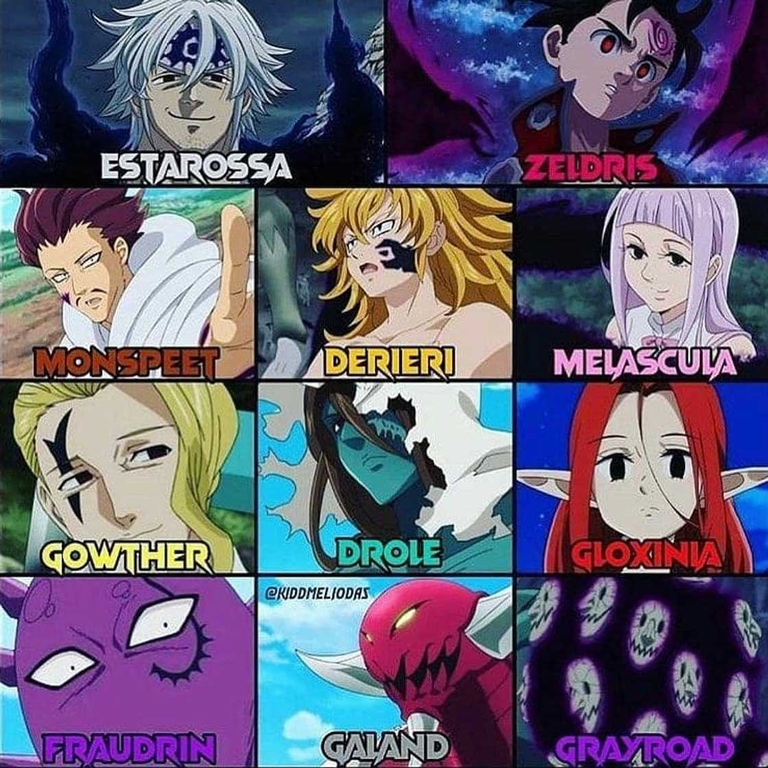
For being the main villains of the arc, most of the Ten Commandments are complete jobbers who look cool and then die immediately without any real characterization. You've got Galand who has this awesome helmet and spear and seems like a major threat until Escanor kills him in one hit and turns him to stone. Then there's Grayroad who has the pacifism commandment that ages people if they kill in front of her, but she gets captured off-screen basically and never feels threatening. Fraudrin is just a filler villain who possessed Dreyfus in the first season and his whole deal is being bitter about not being a real Commandment, which is exactly as interesting as it sounds, which is not at all.
The only two Commandments who get any real development are Monspeet and Derieri, who have this weird creepy romance going on where he uses his flame powers to light her cigarettes and she punches things really hard. They actually feel like characters with history and relationships rather than just obstacles for the heroes to overcome. Drole and Gloxinia are interesting because they used to be the Giant King and Fairy King respectively before joining the demons, but their turn to the dark side isn't explored enough in this season and feels rushed. Zeldris has potential as Meliodas's younger brother who is angry about the betrayal, but he spends most of the season standing around looking cool with his sword. Estarossa is confusing until later seasons reveal his true identity, so in this season he just comes across as a creepy guy who loves his brother way too much and kills Meliodas with his full counter ability that works on physical attacks instead of magic.
One detailed critique pointed out that the overabundance of special backstories for every character starts to feel forced, with everyone being a former king or a demon prince or a goddess reincarnation, and the Commandments suffer from this too because instead of being scary demons they're just another set of characters with tragic pasts that get explained in exposition dumps. The season ends with most of them still alive but barely characterized, which makes the whole arc feel like a setup for something bigger rather than a satisfying story on its own.
Side Stories That Drag the Pacing Down
The middle of this season gets really bogged down with side quests that feel like padding to stretch the episode count to 24. Ban's backstory with his foster father Zhivago and his time in Purgatory trying to revive Elaine is actually emotional and well done, but it takes up way too much screen time and disconnects him from the main group for episodes at a time. Then you've got Diane losing her memory and thinking she's a giant from thousands of years ago, which forces King to go through this whole subplot to restore her memories that basically just resets their relationship progress from the first season. It is annoying to watch because you know it's going to get fixed eventually so it just feels like stalling.
Gowther's backstory gets revealed here too, showing that he's actually a magic doll created by a demon named Gowther the Selflessness who was a former Commandment, and he had this relationship with a princess named Nadja who died, which is why he erased Diane's memory because he doesn't understand emotions. It is sad stuff but it gets explained in such a rushed way with so much exposition that it loses impact. Meanwhile King Arthur and Camelot get completely sidelined after being built up in the first season, with Camelot falling to the demons mostly off-screen and Arthur barely getting to do anything cool. The season spends more time on Diane's amnesia than on the actual war against the demon clan, which is a terrible prioritization of screen time.
The Production Values Are Still Fire
At least the show looks and sounds amazing even when the writing is making you roll your eyes. A-1 Pictures brought their A-game for most of the major fights, with fluid animation and bright colors that make the magic attacks pop off the screen. Hiroyuki Sawano is back doing the music and while the new tracks aren't quite as memorable as the first season's bangers, they still hit hard during the emotional moments and the big battles. The character designs stay consistent and expressive, and when Escanor starts glowing with sunlight the visual effects are genuinely beautiful to watch.
The voice acting is solid across the board, with Yuki Kaji continuing to nail Meliodas's range from goofy pervert to serious demon prince, and the English dub holds up well too if that's your preference. The only visual downside is the CG animation for Hawk's mom, which looks terrible and out of place compared to the 2D animation everything else uses. But for the most part, this is a good-looking show that moves well and keeps your eyes engaged even when your brain is checking out during the power level explanations. Some Reddit users noted that despite the story issues, the animation and music keep the season entertaining enough to binge.

The Setup for What Comes Next
By the time the credits roll on episode 24, not much has actually been resolved. The Ten Commandments are still mostly alive and kicking, Meliodas has been revived but is acting weird and distant, and the Sins are separated again with Ban heading off to Purgatory for real this time. The season ends with a big battle where all seven Sins finally fight together against Melascula and some other demons, but it feels more like a mid-arc climax than a season finale. This is definitely a transitional season that exists to move pieces into place for the War of the Gods arc that comes next, which explains why so many plot threads feel unfinished.
The problem is that transitional seasons still need to be satisfying on their own, and this one struggles with that because it sacrifices so much of its runtime to setup and side stories. When you look back at what actually happened, it's basically just "the Commandments woke up, beat everyone up, Escanor showed up and flexed, then Meliodas died and came back." That's not a lot of plot progression for 24 episodes, and it makes the season feel padded even though the pacing somehow still feels rushed when it comes to character development. If you're in it for the long haul the setup pays off later, but as a standalone viewing experience it is frustratingly incomplete.
Look, The Seven Deadly Sins Revival of the Commandments isn't terrible but it is definitely a step down from the first season in terms of writing quality. You've got amazing animation, one of the best new characters in recent memory with Escanor, and some genuinely emotional moments with Ban and Elaine, but the power scaling nonsense and the underdeveloped Commandments leave a bad taste. If you can ignore the numbers and just enjoy the spectacle, there's fun to be had here, especially when the sun comes out and Escanor starts swinging Rhitta around. Just don't expect the tight storytelling of the first season because this one is setting up dominoes for the next arc while barely moving its own plot forward. Watch it for Escanor, tolerate the rest, and maybe keep a calculator handy if you actually care about who has the bigger power level.
Frequently Asked Questions
Is Revival of the Commandments season 2 or season 3?
It is the true second season of the anime, though Netflix lists it as season 3 because they count the four episode Signs of Holy War special as season 2. The broadcast order goes Season 1, then Signs of Holy War (OVA), then Revival of the Commandments which is the actual continuation of the main plot with the Ten Commandments arc.
What episode does Escanor appear in Revival of the Commandments?
He shows up around episode 14 or 15, roughly halfway through the season. The first half focuses on the other Sins dealing with the initial Commandments attack while Ban searches for him, and when he finally appears at the fighting festival it is one of the best character introductions in the series.
Is Revival of the Commandments worth watching?
Most fans and critics consider it weaker than the first season due to the introduction of power levels which removes tension from fights, plus uneven pacing with too many side stories. However the animation quality remains high and Escanor is widely praised as a great addition, so while it is a step down in writing it is still worth watching for the action and character moments.
Does Meliodas die in Revival of the Commandments?
Yes, Meliodas gets killed by Estarossa about halfway through the season using the Commandment of Love, which reflects all hatred and aggression back at the attacker with greater force. He gets revived later through the Ten Commandments' curse and his own demon blood, but his death serves as a major turning point showing how outmatched the Sins are.
Who are the Ten Commandants in Seven Deadly Sins?
They are ten elite demons who served the Demon King three thousand years ago during the Holy War. Each possesses a unique Commandment power that curses anyone who breaks their specific rule, such as Galand's Truth which turns liars to stone, or Grayroad's Pacifism which ages killers to death. They were sealed away until Hendrickson and Fraudrin broke the seal at the end of season one.